nga Ilir L.
From the Ballot Box to the Streets
For over 35 years, Albanians have voted with dedication, but the results have consistently fallen far short of the promises. The logic of voting for “the lesser evil” has repeatedly led to the same forces in power or opened the door to radical shifts that threaten democratic values. Similar consequences have been seen in other, more consolidated democracies, including the United States, where a polarized society and duopolistic political arena are now facing a democratic crisis.
In Albania, since the fall of communism, two political parties, the Socialist Party (SP) and the Democratic Party (DP), have dominated the political landscape. The Socialist Movement for Integration (LSI) has occasionally served as a crutch for either. For years, the country lived an unusual paradox: two widely unpopular leaders, both clinging to power after long careers marked by failure and controversy, each presenting himself as the only alternative to the other.
In May 2025, that paradox produced its sharpest verdict yet. Despite a decade of scandal and a cost-of-living crisis, voters handed Prime Minister Edi Rama a fourth consecutive term and a larger majority than before. The system did not merely survive the election; it was reinforced by it. This persistent support did more than keep a dysfunctional machine alive. It made the electorate complicit in preserving a status quo that benefits the few at the expense of the many. A year later, the people who never accepted that bargain would answer not with a ballot but with their presence in the street.
A Historical Glance at Political Stagnation
Since the early 1990s, SP and DP have presented themselves as champions of democracy and EU integration. The DP’s early slogan, “We want Albania like all of Europe,” was later replaced by the SP’s campaign motto “SP 5 EU,” featuring an open palm and the EU flag, as if theirs were the only hand capable of leading Albania toward integration. Yet recent campaigns have resembled pop-folk shows and Instagram memes more than serious political platforms.
In a functional democracy, leaders who repeatedly fail would not have the opportunity to run again. The DP’s first term ended in economic and social catastrophe with the collapse of the pyramid schemes that destroyed thousands of families and left the country in the hands of criminal gangs. Later mandates (2005–2013) were marked by failures in healthcare, education, and justice, culminating in the deadly March 2008 Gërdec explosion, where more than 30 people lost their lives, and the bloody protests of 21 January 2011, which followed a controversial High Court ruling linked to the LSI leader.
The SP has failed in almost all the same areas. After coming to power in 2013 in alliance with the same discredited LSI, it declared war on corruption. But thirteen years later, while macroeconomic indicators may appear positive, everyday reality is bleak. Albania is in the midst of a housing crisis: despite an oversupply of apartments, prices are unaffordable, and Tirana now ranks among the most expensive cities in Europe for housing relative to income. Although Albania is among the poorest countries in Europe by Eurostat measures, with one of the lowest quality-of-life rankings according to Numbeo, grocery prices have surpassed the EU average, placing the country above wealthier nations such as the Netherlands, Spain, Poland, and Hungary.
The healthcare system is in continuous decline. Despite promises of universal healthcare, Albanians are paying more than ever, whether through public-sector corruption or through being forced into private care while still contributing to the public system. A major driver of this decline is the exodus of qualified medical professionals, which lowers the quality of care, raises costs, and further erodes public trust.
Emigration has become a national crisis. In a single decade, roughly 500,000 Albanians emigrated legally, with the actual figure likely far higher once undocumented migration is accounted for. Yet there is still no national emergency strategy to address this demographic collapse. A study by the Vienna Institute indicates the trend will worsen, driven by youth unemployment, low wages, and a lack of opportunity.
At the same time, Albania faces a drastic decline in birth rates. The UN projects that Albania, alongside Puerto Rico and Jamaica, will see one of the steepest declines in births globally by mid-century, with consequences for productivity, consumption, and the sustainability of the social insurance scheme.
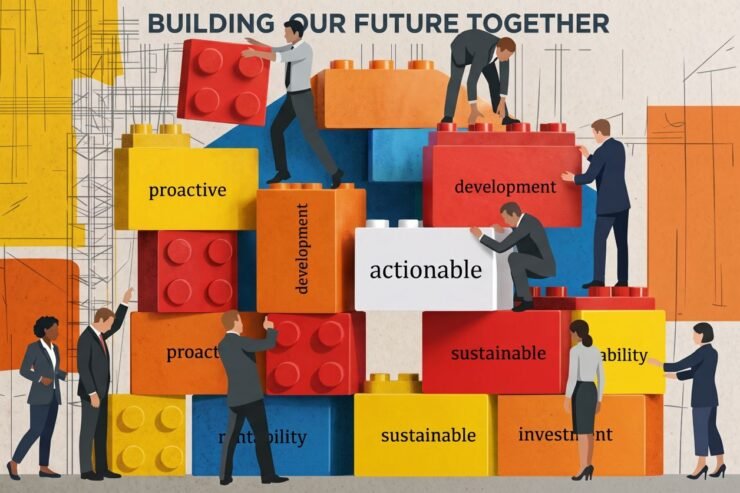
And corruption has not only persisted but intensified. Public contracts, concessions, and infrastructure projects are increasingly scandal-ridden. Corruption is so rampant and normalized that institutions have decayed to the point where it no longer seems to matter whether the citizens they are meant to protect are harmed by contaminated food or untreated illness. The most telling pattern of all has been the quiet handover of the country’s commons to investors close to power. Its shores, its sea, its land, its forests and mountains: every transfer wrapped in the language of “development” and trailed by the smell of a scandal. The arrest of high-level officials is only the tip of an iceberg in a system rotted by clientelism and private gain.
In the face of all this, how can political parties continue to promise economic growth? How can there be a sustainable economy amid depopulation on this scale, or when the primary engine is a construction industry rife with illicit money and, increasingly, with the country’s own protected nature as its raw material?
From Democratic Duty to Democratic Apathy
Albanian society has long struggled to embrace change. Even after the fall of communism, many clung to the past, re-electing the former ruling party in the first democratic elections.
Our political history shows that change has often fallen short of expectations. The DP’s first democratic term was traumatic. Yet rather than maturing into a citizenry that demanded accountability and rotation, society doubled down on preserving the status quo and idolizing its leaders. Disappointment has become normalized in our political culture.
The frustration is loud between elections. We complain about corruption, decay, and despair, and then we vote for the same figures. In May 2025, that ritual delivered its most revealing outcome. The Socialist Party took roughly 52 percent of the vote and 83 of the 140 seats, expanding the majority it held in 2021, while turnout fell to around 42 percent, its lowest in years. Three small anti-establishment groups managed only a handful of token seats between them. The lesson was stark: a decade of scandal and a deepening cost-of-living crisis did not weaken the machine; it instead consolidated a clientelist system and further centralized power in a single pair of hands. The ballot box, the instrument we are told is the answer, had once again renewed the very thing it was supposed to check.
Though many parties exist on paper, real power has remained with SP and DP. Smaller parties and independent voices are structurally marginalized. This duopoly does not encourage innovation or accountability; it preserves an ecosystem in which both sides alternate power without solving systemic problems. Media coverage, campaign financing, and patronage entrench the binary, leaving voters feeling forced to choose between two failed options and believing that votes for new parties are “wasted.”
Talented people are discouraged from entering politics, seeing it as a rigged game. Apathy, cynicism, and disengagement spread. The fear of the “other side” returning to power keeps voters loyal even when their own party betrays them.
In this climate, elections become hollow rituals, and democracy is a shell without substance. As the Pulitzer Prize–winning author Anne Applebaum argues in Autocracy Inc., the new 21st-century autocracies have learned from past mistakes and adopted modern forms of propaganda:
“They don’t offer their fellow citizens a vision of utopia, and they don’t inspire them to build a better world. Instead, they teach people to be cynical and passive, because there is no better world to build. Their goal is to persuade people to mind their own business, stay out of politics, and never hope for a democratic alternative.”
Long-standing political loyalty has entrenched a system that rewards mediocrity and corruption while punishing merit and integrity. Honest people find it harder to advance in public administration, where posts are distributed by party loyalty, and that exclusion has driven professionals abroad. A society where competence is irrelevant and loyalty is everything cannot move forward. When the state loses its professionals and its engaged citizens, the bond between state and society is fundamentally broken.
Patrimonialism and the Capture of the Commons
To grasp what happened next, it helps to name the system precisely. We must stop treating political figures as gods, saviors, or “fathers of the nation,” because in doing so we reinforce their role as patrimonial rulers. As Max Weber described, the patrimonial ruler treats the state as personal property; his authority rests on personal loyalty rather than institutional legitimacy. This logic feeds corruption, clientelism, and, in time, authoritarianism.
Unlike classical authoritarianism, patrimonialism can coexist with democracy for a while. But over time, it corrupts institutions and degrades governance: civil servants leave, rules are ignored, and the state becomes personalized. Leaders such as Orbán, Erdoğan, and Putin, before the war, followed this model. As scholars Hanson and Kopstein argue in The Assault on the State, patrimonial regimes carry two fatal flaws: incompetence and corruption. They are constantly at war with the rules and institutions that stand in the way of rigging, looting, and hollowing out the state.
Nowhere is that war more visible than in the treatment of Albania’s protected land. In February 2024, Parliament approved changes that effectively lifted the ban on construction inside protected areas. On paper, it was a technical amendment; in practice, it was the legal key that unlocked the commons for private capture. It is the purest expression of patrimonialism imaginable: a coastline that belongs to everyone, re-zoned so that it can belong to someone. This is precisely the kind of legal framework that any serious reckoning would have to repeal.
This is also why institutions like SPAK matter, and why they are attacked from both left and right. Though young and not yet fully consolidated, SPAK has been earning public trust, notably after the arrest of Tirana’s mayor, Erion Veliaj. SPAK has now opened an investigation into the changes of ownership rights in the Vjosa-Narta protected area, a sign of what accountability can look like when it is allowed to work. But SPAK cannot succeed without sustained civic pressure behind it.
The Crack in the Circle: Zvërnec and the Flamingo Revolution
On 23 May 2026, residents of the villages of Zvërnec and Nartë in Vlorë County began gathering against the construction of a luxury resort. The project, estimated at around $4 billion, is being developed by a company linked to Jared Kushner’s Affinity Partners, with Qatari co-investors. It would rise on the Vjosa-Narta protected coastal landscape and on the uninhabited island of Sazan, a former military base. The wetland is among the last largely untouched coastal ecosystems in the Mediterranean, home to flamingos, seals, and sea turtle nesting sites. Permits, critics note, were granted in 2025 but never officially published; the legal ground for the whole scheme is the February 2024 law that removed the protection.
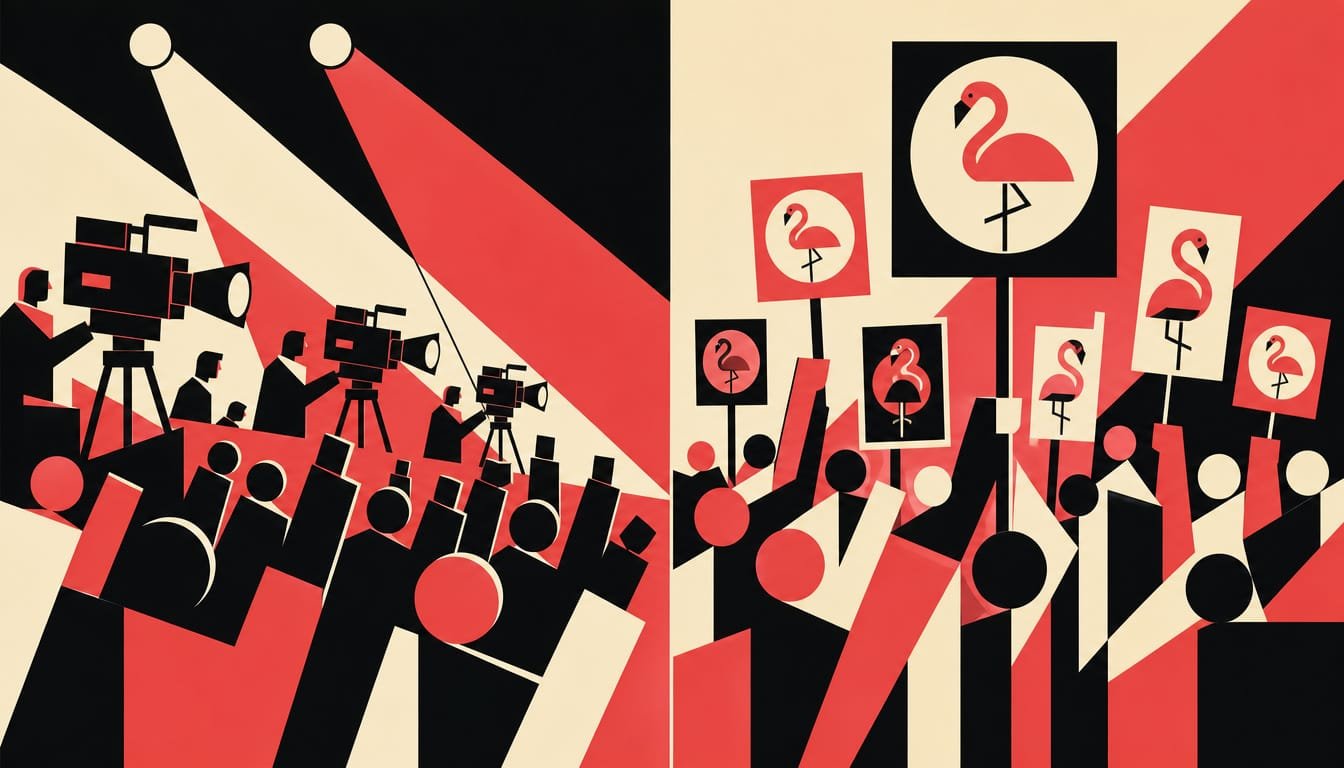
On 30 May, private security personnel assaulted activists and residents while police stood by and did not intervene, and a demonstrator was dragged inside the fenced site. The footage spread within hours. What had been a local dispute over a fence became a national movement. Thousands marched in Tirana for days; solidarity protests followed in other cities and across the diaspora, from Milan and Florence to London, New York, and Toronto. The pink flamingo of the lagoon became its emblem, and the press gave it a name: the Flamingo Revolution.
The government’s response has been to reframe the argument. It insists the protesters are against development, against investment, against Albania moving forward, and the Prime Minister has mocked citizens by suggesting they do not even understand their own demands, asking how the laws could possibly be repealed if the people want him gone. This is dishonest, and it inverts the real sequence. The protest was never against development. It is against the capture of public goods dressed up as development: a corner of the country, a foreign investor with money, an arrangement no one is allowed to see.
That is why the demands did not stop at halting the bulldozers. They escalated first to the repeal of the laws, decisions, and mechanisms that enabled the giveaway of protected areas and public space, then to the resignation of the government itself and, tellingly, of the opposition leadership that backs the same project. For the first time, the street named the duopoly as a single organism. The reasoning is not contradictory, as the Prime Minister claims; it is exact. A government this deeply compromised cannot be trusted to repair the system it built and profited from for thirteen years. It cannot be both the author of the problem and the guarantor of the solution. Resignation is not an alternative to repealing the laws. It is the precondition for repealing them honestly.
The demand did not stay confined to Albania. On 17 June 2026, the European Parliament, in its resolution on the Commission’s 2025 report on the country, aligned itself with the protesters and called on the government to impose an immediate moratorium on all new permits, construction works, and development interventions in protected areas until the 2024 amendments to the Law on Protected Areas are repealed and full compliance with EU nature-protection standards is ensured. It framed this not as a favor to Albania but as a condition of accession, tied to the closing benchmarks of Chapter 27.
Conclusion
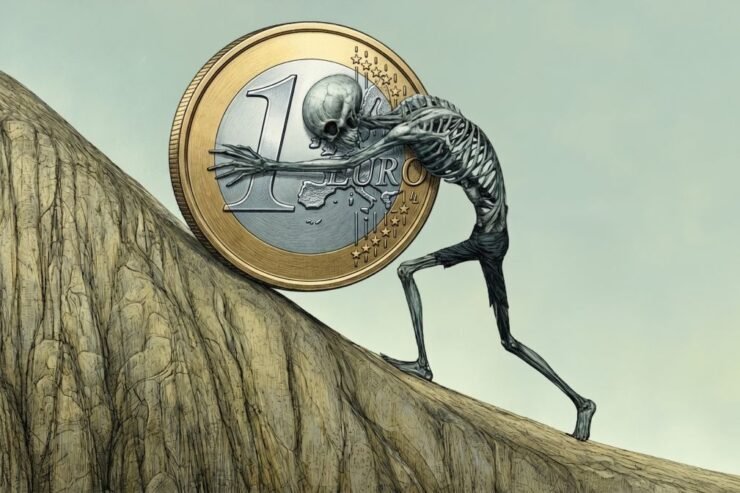
For 35 years, the vicious circle held because complicity was the only verb on offer. We voted out of habit or fear, treated leaders as untouchable, and surrendered our right to genuine representation, and in May 2025, we did it again, more emphatically than ever. By every measure of the old logic, the circle had closed for good.
Then the logic itself changed. For three and a half decades, Albanians had behaved like supplicants, petitioning better masters for better treatment, accepting that the state belonged to whoever held it. Zvërnec was the moment a critical mass stopped petitioning and started reclaiming. The fight was nominally over a fence on a lagoon, but what was really at stake was ownership: who the commons actually belong to. And once people decide the coastline was never the government’s to sell, they are a short step from deciding the country was never the government’s to keep. That is not a change of mood. It is a change of political consciousness, the one thing thirty-five years of voting never produced.
The people who filled the squares were, in large part, the young: the ones who never idolized the figures this essay has warned about, who have the least to gain from clientelism and the most to lose to emigration. They did exactly what the autocrat’s playbook is built to prevent. They refused to mind their own business, to be cynical, to believe there was no better world to build, and it is almost too fitting that a flamingo became the symbol of that refusal.
None of this guarantees an outcome. Movements stall; governments wait them out; the machinery of patronage is patient, and a society can glimpse its own power and still flinch from using it. But the significance of this moment does not hinge on whether the resort is ever built. It is that the circle has, for the first time, visibly cracked. Not at the ballot box, where it only ever renewed itself, but in the street, where citizens finally located the source of their own power and recognized it as theirs to wield. Democracy was never going to be handed back by another vote for the lesser evil. It has to be taken, and taking it demands active, informed, and courageous participation. This is the first step toward a more mature and democratically conscious society.
© 2026 Ilir L. Të gjitha të drejtat janë të autorit.
References
- International IDEA, Global State of Democracy — Albania, May 2025 (Socialist Party fourth term, 83 of 140 seats).
- OSW Centre for Eastern Studies, “Albania: a fourth term for Prime Minister Edi Rama,” May 2025.
- Al Jazeera, “Why the Kushners’ plan to build an Albanian resort has sparked protests,” June 2026.
- Euronews, “Protests against luxury resort in Albania linked to Jared Kushner,” June 2026.
- CBS News, “Jared Kushner-backed luxury resort stokes days of protests in Albania,” June 2026.
- France 24, “Albanians protest Trump-linked resort development planned for nature reserve,” June 2026.
- World Bank, Albania Country Overview.
- Numbeo, “Property Price to Income Ratio in Europe,” 2024.
- Eurostat / Revista Monitor reporting on food prices in Albania exceeding the EU average, 2024.
- Vienna Institute for International Economic Studies, “Albania: Migration Trends and Forecasts,” 2023.
- United Nations DESA, “World Population Prospects 2022.”
- SPAK Annual Report to the High Prosecutorial Council, 2024; investigation into the protected status of the Vjosa-Narta area, 2026.
- Anne Applebaum, Autocracy Inc. (2024).
- Jonathan Hanson and Jeffrey Kopstein, The Assault on the State (Oxford University Press, 2023).
- Max Weber, Economy and Society (University of California Press, 1978; orig. 1922).
- European Parliament resolution on the 2025 Commission Report on Albania, 17 June 2026 (calling for an immediate moratorium on new permits and construction in protected areas pending repeal of the 2024 amendments to the Law on Protected Areas and full compliance with EU nature-protection standards).
Discover more from Peizazhe të fjalës
Subscribe to get the latest posts sent to your email.