On the Albanian Protests (III)
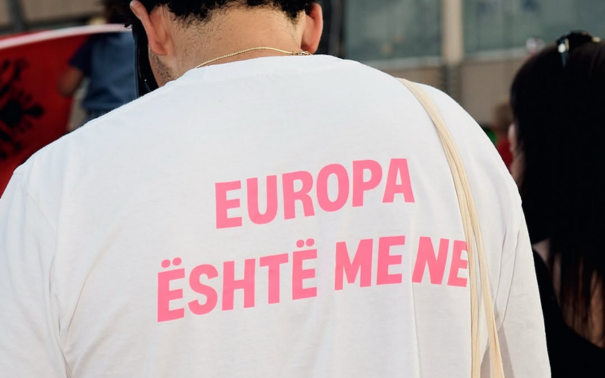
Let me begin with the obligatory disclaimer, because otherwise half the room will start hyperventilating: Albania joining the European Union would be a great thing. I want Albania in the EU. Most Albanians want Albania in the EU. If there is one thing this country can agree on, besides the fact that everyone else can’t drive, it is that we would rather be inside Europe than outside it.
The EU’s importance in Albania would be impossible to overstate. First, because Albanians are overwhelmingly pro-EU. In 2025, 91% of Albanians said they supported EU membership.[1] Second, because the accession process is expected to be the disciplining mechanism that keeps the political system from veering too far from the rule of law. Because Albanians are so pro-EU, any criticism of the Albanian government by EU officials becomes big news and requires a response. The EU is a consequential referee in Albanian politics.
In my first and second articles, I argued that Albanian protests are rooted in a long history of land dispossession and a macroeconomic situation that fails to distribute the benefits of growth widely. Combined with a corrupt and clientelist state that has captured the median voter and allows him or her no escape from the current system, the protests seem almost inevitable.
In this piece, I am going to argue something a bit more uncomfortable for the Europeans: when European funds are spent through a clientelist, corrupt state, they tend to be tainted by its internal logic and, in the process, may end up increasing the incidence of rent-seeking that they aim to reduce. Because the Albanian state is a rent-seeking entity, and political competition between the two major parties is mostly about who captures those rents, increasing the pot size increases both the competition and the rent-seeking activity. Supposedly, European money aims to change Albania’s incentive structure, but by going through its distorted incentives, it may exacerbate those distortions.
What happens when EU money enters the system? The answer is not simple. The EU pushes Albania toward cleaner rules, stronger property rights, stronger courts, and democratic accountability. All of it is good. But the accession process also sends funds, grants, and tenders into a state that has not yet been cleaned up. And that is where things get murky. Because, in a normal state, EU funds subsidize productive investment. In a rent-seeking state, EU funds also subsidize the competition to control access to funds.
The economics of this are well-worn and well-known. Murphy, Shleifer, and Vishny made the basic point decades ago: rent-seeking, an activity that gains wealth by extracting value from others rather than creating it, is especially costly when it’s more profitable than productive activity. They argue that rent-seeking can be self-reinforcing once enough people start competing for rents. Their related paper on the allocation of talent argues that growth depends heavily on where able people go: toward entrepreneurship and production, or toward rent-seeking. Countries grow when talent flows into building things; they stagnate when talent flows into capturing things.
Translate that into Albanian, and it becomes painfully familiar. If the highest returns are in building a company, exporting, or farming, talent flows there. But if the highest returns are in grant applications, permits, and donor compliance language, then talent flows there instead. Rent seeking is an allocation signal. It tells smart people where the money is. That is why EU funds can have unintended effects. They increase the value of knowing how to capture those flows. In a country with clean institutions, that capture is limited by rules. In a clientelist state, access itself becomes the product.
Let’s put some numbers on this, because otherwise the argument can sound too abstract. Albania’s 2024 nominal GDP was about €25 billion. Against that, the EU’s Reform and Growth Facility allocation for Albania is €922 million in grants and favorable loans, about 3.6% of 2024 GDP. By May 2026, Albania had secured €212.8 million in cumulative disbursements, about 0.8% of GDP. IPA III for Albania for 2021–2027 is listed by SASPAC at €524.85 million, about 2.0% of GDP, or roughly 0.3% of GDP per year if averaged over seven years. Now, these numbers are not all annual flows. Some are loans rather than grants. Some are disbursed over many years. Some pass through investment frameworks rather than directly into the state budget. So this is not a claim that EU money is a macroeconomic tsunami.
The point is more specific: in a small economy, even sums that look modest as a share of GDP can be enormous inside the sectors that compete for them. They create firms, consultancies, NGOs, and local networks of expertise and access. They create people whose job is not to produce a good or service, but to know how to move through the funding architecture. They create ecosystems. And in Albania, ecosystems quickly grow brokers.
In what follows, I will pick two cases to illustrate the point. I want to make sure I am not misunderstood here: the EU’s goals are laudable, and the funds are a much-needed boost to local development, infrastructure, and civil society. It’s just that they may end up being captured by and boosting the career prospects of political hacks with nothing to offer other than a hefty Rolodex.
1. The IPARD Case
The IPARD programme (Instrument for Pre-Accession Assistance for Rural Development) is meant as a way for the EU to prepare candidate countries’ agriculture and rural economies for membership, before they enter the Union. It’s supposed to help farmers and agricultural communities in candidate countries comply with EU standards, improve food safety, increase output, and achieve a variety of other noble goals. When the European Commission greenlighted IPARD II for Albania in 2018, it mentioned these and other goals in its statement.
Albania badly needed such a programme. The agricultural sector was fragmented, undercapitalized, and largely engaged in subsistence farming, with crumbling infrastructure. The programme’s budget was about €94 million, with €71 million from the EU and about €23 million from the Albanian government.
Technically, the system is rule-bound. The Ministry’s Managing Authority designs the programme and the calls. AZHBR/ARDA, the Agriculture and Rural Development Agency, acts as the IPARD Agency. It handles project selection, authorization, controls, debt management, and internal audit. The EU provides the framework and a large share of the funding, but Albanian institutions process the files, select the projects, monitor implementation, and make the payments.
Naturally, the rules are there to prevent abuse, but in doing so, they create a gate for each step of the application process. Those gates are there for a reason, and often they open the door for consultants who, in principle, can help applicants navigate the rules. But in Albania, those consultants are not merely there to help fill out applications and provide guidance; they become the gatekeepers with insider information and exclusive access. At least that’s what the OLAF office found.
It investigated serious allegations of misuse of IPARD II funds in Albania. One allegation was that applicants were obliged to pay a large percentage of their grant to “pre-selected” consultancy companies, which would then facilitate contracts with ARDA/AZHBR. After digital forensic searches and other investigative steps, OLAF said it found serious irregularities in both the grant-awarding and project implementation phases. These included applicants being asked to pay a sizeable part of their grant to a local consultancy company, contracts awarded without competition or through rigged competition with fake offers, inflated prices, and breaches of contractual rules. OLAF recommended that €33 million from the first and second IPARD II calls be treated as ineligible, and that €112 million of future IPARD III funding be protected until Albania implements remedial measures. OLAF also sent its findings to the Albanian judicial authorities because of possible criminal activity.
The mechanics are simple to understand: the barrier to entry is high, so consultancies can provide services to reduce that barrier, but the consultants can also provide access to the right people and agencies, so that your bid can get that extra push to get on top of the file. Amfora’s interviews with farmers describe exactly this kind of world. Farmers said the documentation burden was heavy, the process required professional help, and the costs of preparing a file could be prohibitive. One applicant said it took six months and around €20,000 to prepare the file. Another farmer said ordinary farmers could not spend that kind of money on a project that might be rejected. Amfora also reported allegations from interviewees that some consulting offices had corrupt relations with ARDA/AZHBR and that the alleged “tip” could be 30–40% of the grant.[2]
This is how the programme eventually selects for the wrong applicant. The real farmer may have land, labor, and knowledge of the crop. But he may not have liquidity, a clean title, time, or the ability to pre-finance a project. The better-connected applicant may fake all those things. The result is that a programme designed to help farmers can end up favoring people who are politically connected, and in some cases, know as much about farming as I do (academic here).
At the core of this is a failure to properly account for incentives. Suppose you are a politically connected consultant and are on the hunt for clients. You need to lure someone into applying first, so you can get your cut. You can easily access records and find someone who does not have a clear title to their land. You then approach that person and tell him, “Your paperwork is weak. Someone else can move faster using an IPARD grant to usurp your land. You can hire me, and I will protect you.” The consultant is essentially exploiting the ambiguity of property rights to induce the victim to file a project so he can appropriate 30-40% of the funds. His threat is not entirely true, but there is enough truth to it, and the victim has seen enough expropriations to take it seriously. If the project goes through, the potential owner secures his position in the land by “using” it as farmland, and the consultant receives a share of the funds. The project is irrelevant to both parties because neither is driven by its outcome. The consultant has everything already lined up: the builder, suppliers, and the person at the right office who will expedite the project. The consultant also gets a share from inflated supplier prices. Something will eventually get built, but it just won’t produce much in the end.
This is not to say that IPARD did not fund some deserving projects. It may well have. The problem is that a substantial portion of those resources may have gone to fund the same exact clientelism and corruption that I wrote about in the second piece of this series. EU funds matter, and they can do a world of good in a country that needs them. But they need a level playing field and a set of rules applied without intermediaries. Rightfully, the EU has suspended IPARD III funds. The question remains, though: given the large numbers of programmes in Albania, how much of this funding is being appropriated by political brokers?
2. Civil Society
Shaping civil society is one of the intractable problems in the EU’s relationship with Albania. It needs a healthy civil society to provide checks on the relationship between the governing and the governed, but can it create it from above? Civil society is not supposed to be built from the top down. At its healthiest, it starts from the bottom. Citizens get together because they notice something is wrong, not because a donor has opened a call for proposals. That is the natural order: grievance first, organization second, funding third. But donor-built civil society reverses the order. First comes the funding call, then the project title, then the workshop, and the banner. Somewhere near the end, the citizen appears. The old literature on Balkan NGOs has already warned about this. This phrase is useful: “projectization.” NGOs become project organizations, and that can restrict their development as the voice of social movements.
The second problem is dependence on the state. This can take many forms, but let’s concentrate on the three main ones. First, funding dependence: many CSOs live project to project, and a grant can decide whether an organization survives another year. Second, access dependence: even a directly EU-funded organization may need government data, municipal cooperation, invitations to consultations, or letters of support. Third, legitimacy dependence: the EU wants “civil society participation” in the accession process, while the government seeks to show Brussels that civil society has been consulted. This creates a market for polite, professional, grant-compliant NGOs that can attend roundtables, produce policy briefs, and give the process a participatory gloss. The danger is that the system rewards a particular type of civil society that is acceptable to the government and rarely challenges. Civil society becomes critical enough to satisfy the donor, but not so critical that it loses access to the government. That discourages real bottom-up organization. The average citizen looks at the NGO world and does not see neighbors organizing around a shared problem. They see another professional class in Tirana, close to ministries, invited to consultations, and somehow always present when “civil society” is needed. Eventually, this delegitimizes actual civil society because the government has enough “evidence” to show that civil society has been engaged. The workshops, the banners, the dinners, the funds, the glitzy parties, they all serve the same function: to provide enough cover that civil society has been consulted.
The Veliaj/Xoxa file presents a more severe version of this risk. Citizens.al’s summary of the SPAK file says Erion Veliaj and Ajola Xoxa were sent to trial on corruption, money-laundering, asset-concealment, and abuse-of-office-related charges, and that non-profit organizations were allegedly part of the money-flow structure surrounding construction permits and public funds. In a clientelist state, NGOs can also become façades, patronage instruments, or reputation laundries. Just to give the reader a benchmark. As of 2024, there were more than 13,000 non-profit organizations in the country, five for every thousand Albanians, and nearly 60% were inactive.
The EU thinks it is funding accountability. Sometimes it is. But if funding flows mainly to organizations that are government-tolerated and socially disconnected from the grievances they claim to represent, then it may also crowd out the messier, angrier, bottom-up civil society that Albania actually needs and is displaying currently.
The more damning indictment is that Albania has spent thirty-five years funding civil society while the single biggest civil-society issue in the country — land rights — has been screaming at everyone for years. This is the issue that determines whether people own their homes, fields, inheritances, and futures. It still destroys families and sometimes gets people killed. A serious civil society would have built a national movement around former owners, farmers, women excluded from inheritance, and everyone trapped in the same maze. It could have pressured every government to finish the cadastre, protect users from dispossession, and make property security the central democratic demand of the state. Instead, apart from some sporadic efforts, the professional NGO ecosystem failed to turn Albania’s most important grievance into organized civic power. While ordinary people were stuck in ambiguity, too much-funded civil society was busy producing the usual soft theatre: conferences, panels, dinners, trainings, workshops, visibility banners, and polite reports about “stakeholders.” Albania did not lack a cause around which civil society could have been built. It had the cause. It still has it.
[1] If you think that number is too high, I did too. My first thought was that even in the old communist days, election numbers didn’t get that high. But I checked several other polls, and the trend seems pretty consistent. 2009, 88%, 2020, 2021, 97%, and so on.
[2] The Amfora article has some really interesting investigative cases, especially involving politically connected people and their children receiving enormous sums for companies they’d just set up.
© 2026 Elton Dusha. Të gjitha të drejtat janë të autorit. Cover image © Zeni Alia.
Discover more from Peizazhe të fjalës
Subscribe to get the latest posts sent to your email.