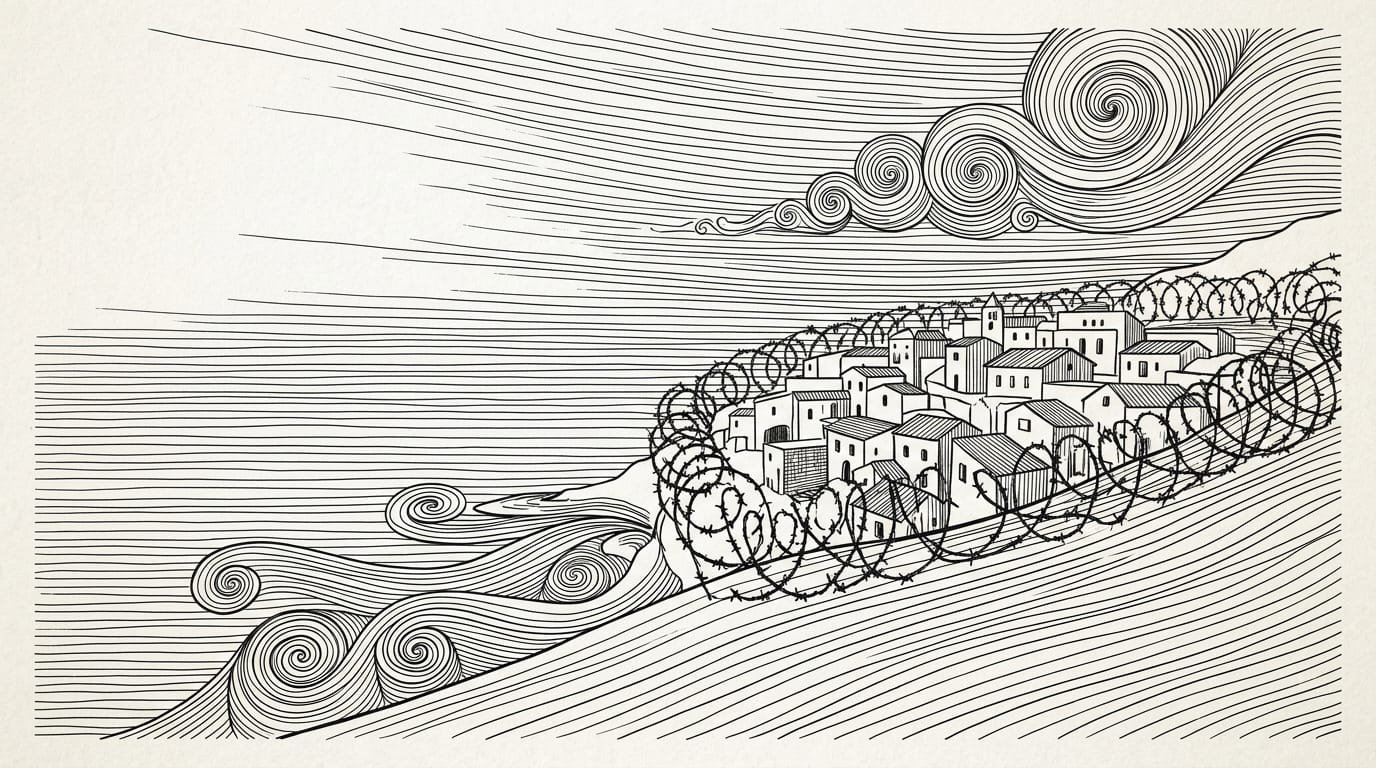
As far as empathy was concerned, the people of that village received none.
What suffering could they have known, these people who had spent their entire lives by the sea?
Because it was difficult not to think of their lives as filled with eternal bliss, it was also difficult to pity them. Those who had spent any time vacationing there were especially dismissive of their concerns. The beauty of the villagers’ surroundings, these visitors reasoned, should have been compensation enough. Whatever misfortune that might occur to them should have been understood simply as a balancing of the order of things. To want anything more would have been greedy, especially when they, the visitors, spent most of the year in dull, gray cities, postponing their living until the next time they could come to the village, whose calm and beauty would reinvigorate their spirits.
And it was true: it was beautiful there. Where else did the earth descend from the mountaintop to the sea so elegantly? Gentle slopes gave way to glorious vistas, where one could observe how the water asserted itself in front of its two competitors, the open and endless sky, capable of transforming itself into countless shades, and the greenness of the land, so crowded with abundance that it was impossible to enumerate all its gifts. And so in response, the sea put on a show of dramatic and powerful waves, whose crashing could be heard across the distance, offering a pleasant soundtrack to each moment of the day and of the night. The blessings were so endless, that if they, the visitors, ever had the chance to settle in this village, they would never complain again for the remainder of their days.
Along the slopes above the shoreline, the villagers had built their homes. They were humble, yes, but again, what need did they have for luxury, when they had been given everything that the natural world could provide? They lacked for nothing. Not for the fruit they could pick straight from their trees, not for the milk gifted by their cattle, not the fragrant honey made by their bees.
But above all, it was their proximity to the sea that made these villagers appear truly blessed in the eyes of visitors, who envied this bay’s seclusion from the rest of the coast, a ruggedness difficult to find anywhere else in the country.
In that small bay, the visitors contended, nothing man-made existed except an old jetty. Everything else—the thorny bushes, the rocky shore, the yellow-horned poppies—was natural, and in the eyes of the visitors, untouched. It didn’t matter that the villagers labored under all weather, when the sun burned hot in August, or when storms flooded the area in autumn. This labor, made invisible by outsiders’ unwillingness to see, naturally went unnoticed, and with time, the virginal metaphor became so widespread that the village and its beach earned a reputation. It attracted both adventurers seeking their next thrill in areas that still held a sense of danger, and moderate vacationers looking for something far more elusive, an authenticity easy to capture and understand. And when either party didn’t find what they were looking for, they blamed the villagers, who they thought incapable of making the most of what they had been given. How unjust it seemed that the sheer arbitrariness of their birth had blessed them and that now they were squandering that blessing. Had this land been the property of other people, people with good heads on their shoulders, the visitors would lament, its real potential would have been reached a long time ago.
You see, the visitors thought of themselves as sophisticated people, educated, well-versed in history and up to date with current affairs. And above all, they thought of themselves as people of great empathy. So it was significant that, when foreign developers, drawn by promises of unspoiled land, descended upon the village and its beach with plans to construct a luxury resort, the visitors had to admit that it must have been their fault: they had given the villagers the evil eye and set this curse onto them.
They reasoned that their envy, transformed into rumors and critiques, had crossed the confines of that country, and in time, had attracted the interest of eager profiteers who set their sights on the village’s most beautiful beach, located in that small, sheltered bay framed by green land that rose softly above the sea, so blue it could make you forget all your troubles. They claimed that when the plans were drawn, the contracts signed, and the money exchanged, no one spoke for the people living in the village, precisely because their envy, distributed as it had been over the years, had made people blind to the villagers’ suffering, and had turned them, in the eyes of the developers, into one large, anonymous mass of unwanted troublemakers.
As the developers had predicted, it didn’t take long for the nuisance to grow, to contradict them, to put on a show of their disagreement, to draw media attention, and in turn, to require a response. But even the special police forces they called seemed to be insufficient: somehow, the villagers kept multiplying, descending on the bay in droves, resolute in their belief that the land belonged to them. That old adage about power in numbers started to falter, however, when the police drew their weapons and the villagers retreated. And the journalists who had reported constantly about the conflict between the villagers and the developers soon departed, taking with them any remnants of public interest.
Still, there was something so appealing about witnessing the suffering of the other. The visitors who had once enjoyed the gifts of this village, now watched with interest the land seizure and confrontations that followed. Of course, they felt sorry for the villagers, and even voiced this sentiment from time to time, extending their theoretical support with great generosity. In reality, and through the help of distance, they found pleasure in following the story of the underdog’s heroic struggle against a merciless enemy. They believed it to be doomed from the start, and because of this, they found it especially dramatic. No matter how many times they heard this kind of story, they could never get enough, and even if the characters were always the same ones, they still gasped whenever the final blows were delivered and the problematic actors were squashed once and for all. And when the story was repeated, and the characters switched roles, so that the oppressor became the oppressed, and the new oppressed learned how to suffer, these witnesses enjoyed the narrative even more.
Each time, the center of the story contained one long, sustained struggle, full of slow-building resentment and the sudden explosions that, by providing temporary relief, kept it at bay.
In this case, the plot unfolded differently.
Like all people who had spent their lives in one place, these villagers knew the area intimately.
After their confrontation with the police went awry, and several of them were arrested, the villagers changed their approach. They waited for the early stages of the construction to begin, allowed the foundation of each building to be laid, and only when the first walls appeared did they carry out their first clandestine action. In the middle of the night, a group of villagers descended on the bay, taking a road hidden by a thick cover of strawberry tree shrubs. When they reached the construction site, they worked in unison, calmly and methodically tearing down what had been accomplished by the firm’s workers that day.
The labor was easy, the construction suffered from great instability.
The group worked all night. They took turns shoveling and hammering, digging and breaking all they could. They rested for no more time than it took them to smoke a cigarette. When dawn broke, they stopped and admired their accomplishments: a pile of ruins, a pleasing assemblage of deconstructed power, the same power they had managed to subvert, if only for a day. The developers, those who were already calling themselves the new owners of the land, wouldn’t discover the destruction until hours later, when the group had long been gone, again taking the path hidden by the strawberry trees and separating once they reached their homes in the village. But it’s not easy, becoming an individual again. All morning, the villagers who had participated in the action were restless and irritable, not because they feared consequences, but because they wanted to join the group again, to finish what they started.
In the bay, the investigation into the destruction of the buildings’ foundations had been short. Though they had no proof, the developers and the police knew the villagers were responsible. They ordered their workers to clean up the rubble, paid for a bigger tractor to speed the process, and by the end of the day, construction was almost ready to restart. As a final act, they installed a few cameras above the construction site. They didn’t bother seeking the perpetrators of the previous night’s crime; they knew the culprits would be back. Catching them in the act, they thought, would serve them better, increasing the criminals’ fines and sentences.
That evening, the group of villagers met in the outskirts that led to the bay. They were joined by many new faces, as word about their deeds had spread throughout the day, and everyone had become eager to find their place in the struggle. Those who joined the group that second night didn’t spend long thinking about their position, they were happy to finally get up and use their hands. At the construction site, they found the rubble cleared, dumped far away from the sight of the prospective vacationers, who in no time, would come to lounge by the sea, their gaze never turned the other way.
The villagers were disappointed: there was little there for them to dismantle. Instead, they gathered wooden sticks they found scattered around the site and someone kindled a fire. Its pleasant crackling and the waves crashing made them feel like they had come together to enjoy an evening on the shore with friends, with no hint of any other motive.
An old woman, well-respected for her tenacity and knowledge of wild plants, and infamous for the public scolding she had given her grandson when he had stolen figs from a neighbor’s tree, who had insisted on joining the group despite her physical weakness, settled by the fire and spoke of a legend from long ago.
Three brothers, tasked with erecting a building, were plagued by an incomprehensible curse: whatever they constructed during the day, they would find in ruins the next morning. Finally, an old man altered the brothers they had forgotten to pay their dues to the entity that controlled that land. The payment—the life of one of their wives, whose body needed to be immured in that edifice, so it would finally stand—had to be administered skillfully. That evening at home, they were to say nothing about this new knowledge, so that fate itself would pick the sacrificial lamb. They swore to it: the chosen one would be the woman who brought them lunch the next day. But for a story to become a legend, a betrayal must happen. Only the younger brother kept the promise, and the next afternoon, with his brothers, he buried his wife inside the structure’s walls, buried her alive and still breastfeeding her child with the breast she begged them to leave exposed. Or, of course, so they say.
When the woman finished telling the story, the group was laughing, wishing to move on. They had heard it hundreds of times before. Most of them thought it was a tedious tale, with symbolism so obvious as to make it superfluous.
But some were offended by the implication that they were operating in the same way as the brothers, working toward an impossible goal, doomed to repeat the same pattern that led to nowhere. Others took an even greater offense with the idea that they had anything in common with the invisible curse or the invisible force that governed the brothers’ world, who demanded a life in exchange for the longevity of their construction.
“You’re not understanding me,” the woman told them, “What I am asking is what would have happened if the brothers hadn’t listened to the old man?”
Her questions felt unreachable, and the group paid her little mind. But in the days that followed, they started to act in ways that showed they had understood: nothing could remain on the beach, and neither could any of them be sacrificed for the sake of their mission.
So when the developers came knocking at their doors accompanied by the local police, the villagers remained steadfast, knowing that not one of them would speak. In reality, they hadn’t had time to discuss strategy if a time like this came, but by virtue of instinct, they knew how bitter betrayal would taste. That knowledge had spread from house to house as easily as air, making the developers leave empty-handed. The villagers couldn’t have known about the camera footage collected, nor that its low quality had benefited them that day, so when construction restarted, and when a wooden wall was placed around the site, they were already making plans for another night of disruption.
One of them, a man known for his artistic spirit, whose house and garden always had a certain unattainable sophistication, suggested adorning the ruins they would leave in their wake with beautiful banners. He volunteered to make the banners himself and got to work immediately, ripping old linen sheets and painting onto them images of the future he envisioned for that beach and that bay. Each banner he painted depicted a scene from what had always been there: an expansive, resplendent sea, rocky sand with speckles of yellow poppies, and green hills as far as the eye could see. Some scoffed at his initiative, thinking it a waste of energy, but had little time to question his reasoning, and left the man to finish his work, which deep down, they found endearing.
The group’s focus had shifted to a new task: collecting the tools necessary to take down their new obstacle, that wooden wall. For an entire afternoon, they moved from house to house, gathering something here and another thing there, until evening descended and it came time for action. Breaking through the wall proved easy, a few hatchets and saws got the job done quickly. When they got inside, the work of dismantling that day’s construction was also of little challenge. Once again, little had been rebuilt, and so after undoing whatever they could, the group had time to carefully affix their artist friend’s banners so that they faced the position of the landscape that they represented. The banner of the sea, they hung in front of the shore, affixed on two thin metal columns. The banner of the sand, they tied to tree trunks, so that it hung slightly above the sandy ground. And the banner of the green hills, they tied to the half-standing wall of one of the would-be hotels, reclaiming, through their imagination, what should have always been there.
After that, the villagers were there every evening. Whatever the workers hired by the developers built during the day, they would dismantle during the night. The group members alternated, so that no one became overworked, and so that everyone who wanted to, could join them. With time, in their inversion of the old legend, they became neither the three brothers indoctrinated by outside forces, nor the woman sacrificed to build the structure. What they embodied, instead, was precisely the intangible and Sisyphean curse that plagued the process of construction.
Until the day that the developers changed their strategy, the villagers felt almost invincible. They had gotten bold, bringing food and refreshments to the bay to sustain their energy, playing music to make the work feel lighter, and even setting up tents for camping there overnight, when they were too exhausted to make the trek back home. To some, it almost felt like they were making a whole new world for themselves down by the sea, and through the intimacy and intensity of that struggle, finally seeing themselves for who they truly were.
Then, one hot August day, the metal gate arrived.
The group should have known the developers were planning a response, but had assumed that the new legal battles that had emerged for them kept them too occupied. As it turned out, the municipality’s sale of the bay had not been lawful, and the villagers’ property claims had been valid. Because they hadn’t expected a response coming so quickly, they experienced the gate as an even bigger shock. It rose to an intimidating height, preventing them from even looking out to the bay and the sea. It was a solid, pale blue, as if it had already been washed out by decades of sun, and it extended so far from east to west that it allowed for no entry into the bay. Even their old, reliable path, the one behind the strawberry tree shrubs, was now cut off.
It was unbearable, the thought that they couldn’t carry out their nightly labor.
Not knowing what to do, the group called for help, sending one of them to alert their families. But there was hardly any need: even in the village, the gate had invaded the horizon. More and more people descended, shouting the whole way, their voices echoing rage across the expanse, announcing their presence before they arrived at the gate.
As the crowd grew, a lone guard emerged from the small guardhouse behind the gate door.
“What do you want?” he asked them, repeating the question each time they yelled an answer, as if nothing they said reached him.
Shaking his head, absolving himself of responsibility, affirming that he knew nothing about anything, the guard made himself an impenetrable wall. When the villagers’ anger intensified enough, they started charging at the gate, pushing it forward any way they could, and in the process, pushing on each other’s bodies, becoming, quite quickly, one being made of multiple sets of arms and legs, bellies and backs, fingers that they pressed on one then another. The guard, confronted with this sudden united force, dialed a number on his phone and whispered, frantically, that he needed some back up there, immediately.
It was midday.
The villagers pressed with even strength on the gate, shaking its foundations, unsettling its stance, the division it had created between what could be called theirs, and what could not. As they pressed, they shouted about justice, ancestry, and the right to the beach. Yes, now that the sun had reached its zenith, and the dust around them shimmered in the sun rays that burned in their faces and shoulders, everything had been made clear: this was the fight of their lives. If the foreign developers, their friends in the municipality administration, the guards and police they employed, and yes, even the construction workers who hadn’t laid down their tools after that first night, wouldn’t take their power seriously before, now they would experience its full magnitude.
When the guard’s help arrived—a slim, unassuming man, wearing a striped polo and claiming to be there on behalf of the land’s new owners—he asked to speak with a representative from the group. Five men emerged from the crowd, and not having time to carry out a vote, encircled the liaison, whose dejected appearance and demeanor betrayed the sternness of his employers’ orders. It was because he looked so miserable that they felt like they could talk to him, not because they trusted him, but because they recognized something essential in him: the look of someone who has compromised too much. The five of them spoke at length with the liaison, in quiet, almost polite terms that would turn into shouts whenever he referred to the contract of sale, the laws and regulations protecting private property, and the sacredness of the unspoken norms of civility.
At the mention of private property and legal documents, many in the crowd took out their own documents, certificates and deeds, yellowed and folded one too many times, and waved them in the face of the liaison. They had proof that they had a claim to the bay, written in the language of the law, one the developers should understand. But when this gesture failed, since the man told them he knew nothing about any legal affairs, he knew only what he was told, and what he was told was that any confusion, any frustration, any question that they had, could be answered at the city hall, the villagers demanded one thing from him: to forget everything else, to let them go to the beach.
If one had been a fly or a bird passing in that air, one would have seen this scene: a small group of men gesturing to one another, and behind them, a crowd, loud and mid-movement, pressing against a gate, and then behind it, a guard standing still, watching and smoking a cigarette, and then behind him, the gentle slopes of two mountains leading toward an open sea.
It might have looked like the self fighting the self.
Despite the hours of struggle against the gate, and the long back and forth between the group’s impromptu representatives and the liaison, little was resolved. By the late afternoon, small groups of teens and children from the village had joined the group, standing gingerly at the edges of the gathering. Noticing this, one woman motioned for them to go ahead to the beach, pointing to the opening in the gate door, where the guard stood and kept watch over all the activity. As if they had choreographed their entrance ahead of time, some of the children managed to distract the guard, tapping him on his legs and hands and causing him, in his confusion, to open the door slightly wider, so that the rest of the children could slip in, quickly and without making any noise. Without hesitation, they ran to the beach, traversing in less than a few minutes what it would take the guard, with his bad knees and back pain, at least half an hour to cross.
In the commotion caused by the children’s transgression, the guard had let the gate door fall open completely, and the women in the group had exclaimed Let us get our children! so loudly that he had been rendered powerless. With little disregard for him and his trembling voice, which implored them to stop, the women ran down to the beach to join the children, some of whom were already in the water, splashing one another with abandon.
The group of villagers left at the top of the mountain found itself in a peculiar new position. They now had the upper hand, owing to the leverage provided by the women and children occupying the developers’ property.
The liaison changed his tune with the ease of a trained professional. Trying to reason with those that remained outside of the borders of the gate, he told them that everything could be solved with some discussion, because the root cause of all this strife was misunderstanding, since, after all, both parties involved cared about the same thing, the well-being of this beautiful, pristine beach and seashore. The developers, he repeated one of the speeches he had already given them, wished to work with the local community, learn from them and, in whatever ways they could, improve this region. It was difficult to listen to him, and even more difficult to believe that he could listen to what he was saying and feel anything but disgust. If that was the price one had to pay for a shot at the possibility of getting out of their small small village, and for gaining the success only a proximity to power could bestow, it seemed impossible that anyone would do it.
“Forget it,” one of the group members said, pushing the liaison to the side and marching straight for the gate door, past the guard, who was still stuck watching the women and children on the beach.
Most of the others followed him, glad to be done with talking. They reached the ruins quickly, and just as quickly they started to set up their temporary quarters, having decided, collectively and without any words, that when night came, they wouldn’t leave the beach. They worked with the materials left there—pieces of wood and tin, scraps of metal, some ropes—and whatever column or piece of wall was still standing. It wasn’t long before the recognizable shape of shelters started to emerge. They had created one long, narrow room, spacious enough for each of them to curl into a position that night, weather the long hours until dawn, and be witness to daybreak by their sea.
This collective, which had transformed from a group of representatives and their witnesses, to a group of builders and their helpers, hadn’t noticed that during their descent to the beach, the old woman, the same storyteller who had reminded them about the tale of the three brothers and the woman they sacrificed, that same woman had snuck into their ranks and was now sitting on a stool made of two bricks stacked together. No one could tell how long she had been there, watching them labor, and no one could tell what she was thinking, her gaze lingering between their knuckles and wrists. She stayed like that for so long that she forced stillness out of them, and they put down their tools, sat cross legged and in a row, facing the sea. The discomfort caused by her presence was lessened when the woman joined them on the ground, nudged one of the men she knew best on the shoulder, and shook her head at their spontaneous audacity.
For the moment, at least, the critic was enjoying what they had done.
Before long, the children returned from the sea, and as soon as they entered the shelter, they filled it with the assurance of an endless present. When the rest of the women and men had joined them, and the shelter became crowded with legs and arms, someone said they should plan their next move. He had read somewhere that adrenaline was what made memories stick in your consciousness, and that its absence would mean a risk of forgetting details from that day. He was afraid the calm that was slowly coming over them meant they were already preparing to forget.
All the playfulness in the water wasn’t appropriate, he thought, even for the young children who had been deprived access to this land for months.
“What will we do in the morning?” he asked.
He repeated the question until everyone started to talk about strategy. Someone said they needed to speak to the village fishermen and get their help bringing food deliveries to them from the bay. That way, she reasoned, they could stay there as long as they wanted.
“We can’t stay here as long as we want,” someone retorted, adding that the duration of their stay should be contingent on how long the developers took to meet their demands.
“What demands?” someone else asked, confused because he thought they had just gotten what they wanted.
Answers began to be thrown around, from the idealistic to the practical, balancing imagination with the pragmatism of people who, for as long as they remembered, had been neglected by all.
Only the artist remained silent, sitting slightly away from the rest of the group, and affixing his eyes to the small clump of yellow horned poppies in front of him. In that late afternoon light, on the edge of daylight and golden hour, the poppy’s leaves looked even more otherworldly than usual, resplendent with a cold, green-blue undertone that, at least to him, felt more alive than anything else around. His banners had fallen down, the wind had flung the painting of the sea far away, to the other side of the inlet, while the other two banners had been buried under the pebbles and debris on the beach. The vibrancy they had lent to the ruins was now gone, and more than the loss of memory, he feared a disconnection from creation.
So he decided to try to get his painting of the sea. As soon as he began to walk toward it, his feet stumbling over the pebbles, the storyteller, who had been his friend since school, got up to help him. She put his arm around his, steadying his body and step. They walked along the shore and no one noticed them. They spoke about their grandfathers, who had been neighbors all those decades ago, and who had gotten along so well that they often herded their sheep together, coming down from the village to the mountains that surrounded this bay.
They didn’t take it for granted that they were surrounded by so much beauty. Sometimes, and this is what each of their grandfathers had told them, they would even take a short, midday break on the beach.
While one of them kept watch of the other’s flock, as well as their own, the other man would take a swim, making sure not to be away too long, so that they had time to switch roles before the day ended. Who knows what the one who waited thought about, as they watched their friend in the sea or as they looked around the mountain slopes.
In moments of tranquility, a man dares to imagine.
It must have been during one of these breaks that their grandparents decided to plant strawberry trees along the path they liked to take to descend to the beach. They wanted shade for their walk, and these trees would grow easily and quickly. When the time and conditions were right, they gathered a few other people and planted the seedlings along the slope, following its natural contours from the top all the way to the bottom. They took care to manipulate the land only as much as it allowed. But they weren’t saints. They created the row of trees for their own benefit, because like the ones who came before them, they were guided by the impulse to improve what was already there.
The artist and the storyteller couldn’t understand why tourist agencies loved to describe their villages, mountains, and their beaches as untouched and unspoiled. As the two of them walked, they talked about the perils of selling the dream of authenticity. They agreed that, when it came to this land, as long as someone was around, there would be interactions and change. And after all, they both reasoned, having had a few minutes of thinking it over, the land was constantly being reshaped by other animals, by the sea, and even by its own weight. In other words, its existence.
I know what they spoke about because the old woman told me one long, vast night, happy to share the philosophical musings she used to have with her friend. She told me the whole story, sparing no detail, from beginning to end, an end that today, I don’t like to dwell on, out of love for the people who occupied the beach, and however briefly, returned that land to its rightful owner: no one but itself.
(c) 2026 Genta Nishku. All rights belong to the author. Cover image realized with Google Nano Banana.
Discover more from Peizazhe të fjalës
Subscribe to get the latest posts sent to your email.