
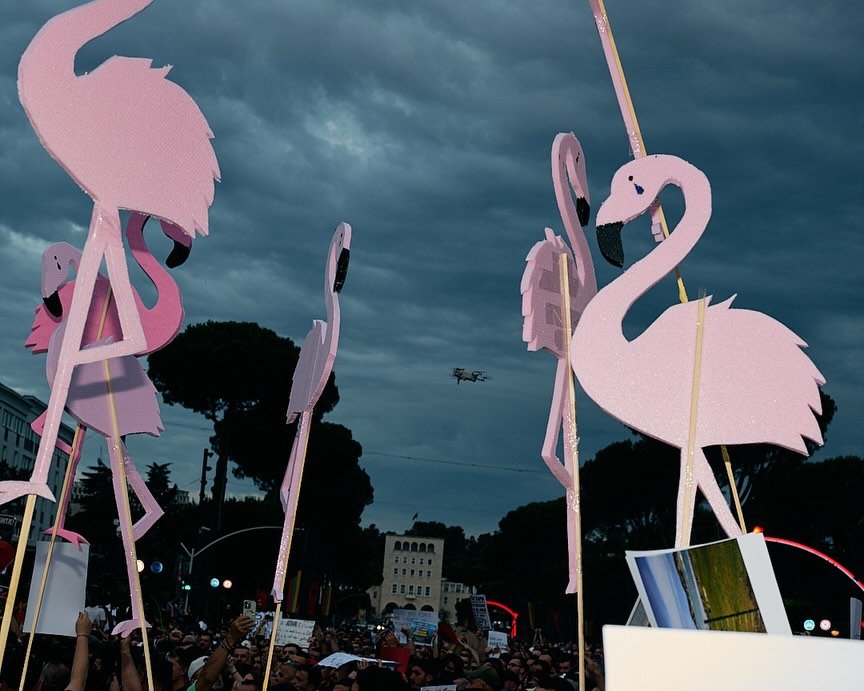
Since the area around Zvernec was fenced off, and local protests against the tourism projects in Narte, Sazan, and Zvernec began on May 23rd, the mood in Albania has suddenly shifted. The protests have grown and have taken the capital, Tirana, with crowds growing each day. The international media is catching up, although the framing has been too focused on Jared Kushner and Ivanka Trump because that story has legs. But the protests are about something much larger; they’re about the systematic abuse of property rights in Albania, dispossession, the corruption of the elite in both major parties, and an affordability crisis that is sending its young people abroad in droves. Zvernec was the straw that broke the camel’s back, but this story has been years in the making, and what you are seeing now is the culmination of resentment and anger that have been seething beneath the surface. The Albanian government has been very good at selling a glitzy image abroad, but, for most of its citizens, that does not fit with their experience at home.
Small protests like the ones in Zvërnec have been taking place across Albania for the past few years. In Rrjoll, residents clashed with police and demanded the suspension of work on a resort that had been declared a strategic investment, claiming that their property was being taken through falsified documents. In Tragjas, residents protested and clashed with police over a water-supply project they said would divert local water toward luxury villa and hotel complexes on the Himara coast, leaving their village without the resource that sustains it. In Theth, residents who had been promised property titles, legalization, and support for family tourism were later met with bulldozers and police, as the state moved to demolish structures it called illegal. And in the Shushica valley, residents from dozens of villages have protested for more than a year against the diversion of river water toward Himara, filing lawsuits and setting up a symbolic resistance tent to stop works. These are different cases, but they share the same structure: in the past few decades, Albanians have lived with land they could use but often could not sell or buy, and they have built on land that they thought was theirs but, legally speaking, was not. How did this happen?
The original sin was Law 7501, passed in 1991, meant to distribute agricultural land quickly after communism, but it settled only the immediate distribution question, not the historical ownership one. For the purposes of the new system, it refused to recognize pre-collectivization ownership, creating a new property order on top of the old one: some families received land in ownership, while others received only land in use. In daily life, that difference often disappeared; people farmed the land, fenced it, passed it down, and treated it as theirs. But legally, use was not ownership, and even ownership was not always a clean, registered cadastral title. Meanwhile, former owners and their heirs later pursued restitution, compensation, or recognition through a separate legal track, resulting in overlapping regimes: post-1991 distribution, pre-communist ownership claims, cadastral registration, and final title. The mechanism of dispossession sits in the gaps between these categories: use, possession, traditional boundaries, AMTPs, cadastral maps, and restitution claims. An AMTP (Akti i Marrjes së Tokës në Pronësi, the Act of Taking Land in Ownership) was supposed to bridge land distribution and private ownership, but it still had to be registered, mapped, and reconciled with other claims. At any point, a claim could be weakened: the boundary redrawn, the land reclassified, the AMTP challenged, another claimant inserted, or the dispute pushed into court for years. The 2020 law on finalizing transitional ownership shows how unfinished this system remained: it tries to convert unresolved claims into ownership, but also allows registration to be refused, suspended, or delayed for many reasons. Most importantly, agricultural land cannot be transferred into ownership freely if it is already the object of a strategic investment. In practice, if the investor arrives before the user receives title, strategic-investor status can become the reason the user never becomes the owner. This is why the system’s opacity no longer looks like a temporary failure of transition. It looks like the operating logic of the system itself. Ordinary people are trapped in legal uncertainty, while those with access to cadastral offices and political power can navigate it with ease. The maze is impossible for citizens to navigate, but useful for those who know its shortcuts. It keeps land unresolved until land becomes valuable, and then it allows the well-connected to turn that unresolved status into ownership, permits, and projects. In that sense, ambiguity is the means through which dispossession is carried out.
The strategic-investor law is the institutional piece that turns this property ambiguity into development. It was presented as a way to attract large domestic and foreign investment by giving important projects faster administrative treatment, a “single window” with the state, and special support from public institutions. Tourism is one of the sectors covered by the law. Once a project receives this status, it becomes a project of “public interest,” handled through priority procedures, coordinated by central institutions, and eligible for support with documentation, infrastructure, land consolidation, and, in special cases, even expropriation. In a normal property system, this might simply be a development incentive. In Albania’s system, where ownership is often unresolved, it becomes much more powerful. Strategic-investor status allows the state to put its weight behind the investor before land disputes have been fully resolved. When the project becomes strategic, the residents’ claim becomes complicated. That is the entire asymmetry.
This is how dispossession happens without a single dramatic act of confiscation. The state does not need to say that people have no relationship to the land. It only needs to say that their relationship is not legally complete. They used the land but did not own it. They owned it but did not register it. They had an AMTP, but the map was unclear. And so on, ad nauseam. While citizens are told to wait for legal clarity, the land has already been fenced, permitted, and transformed.
This sounds abstract until you look at Rrjoll and Zvernec. In Rrjoll, residents say the land they inherited and considered their own was, through documents and institutions, transformed into land available for a luxury resort. They allege that the land was alienated by a former land registry official, while the project itself received a government construction permit in December 2024, covers around 147 hectares between the Viluni wetland and Rana e Hedhun, and is expected to benefit from strategic-investor status. The point is not only that locals dispute the ownership; it is that the person they accuse comes from the very institution that was supposed to secure their property rights.
Zvernec tells the same story on a larger scale. Villagers near the Narta lagoon still had not received property deeds almost thirty years after the state awarded them land, while courts and prosecutors had found that parts of the land had been transferred through forged documents and networks linked to coastal land theft. The development agreements behind the current resort project involve individuals and companies claiming ownership of more than 2.5 million square meters in Zvernec and Narta. Those ownership chains include a former lawyer and property representative convicted over forged land documents, and a company belonging to the family of a former president of the Tirana Court of Appeal, who had previously ruled on cases connected to the same network.
But we still haven’t answered the question: why now? In what follows, I will present two hypotheses that work in tandem. They’re not mutually exclusive, but rather reinforce each other, and have created conditions for a perfect political storm. The projects in Zvernec, Narte, and Sazan are internationally recognizable because they involve foreign actors with a strong media presence, but they are merely the cherry on top of a poisonous cake that has been years in the making.
The short version: Albania is caught between a closing legal window and a broken economic model. EU harmonization is beginning to close the window during which unclear land titles, weak environmental review, and strategic-investor status can be used to push projects through before citizens know what they legally own. At the same time, the Albanian economy has become dangerously dependent on construction and real estate. If that machine slows down suddenly, the country risks a recession, because too much of the growth, lending, and political power is now tied to building. So, the government keeps pushing projects forward because it has built an economy that increasingly needs them. This increases the likelihood of conflict with local populations by intensifying land demand for construction.
But this is not a development model in any meaningful sense. It is an extractive rentier model: land is converted into assets, assets into political and financial power, and ordinary citizens are left with unaffordable housing, insecure property rights, and fewer reasons to stay. The gains are concentrated among a small class of developers, officials, media personalities, and politically connected investors. For the average Albanian, the result is exclusion. Young people are voting with their feet and leaving, while those who remain face a shrinking labor market, higher housing costs, and fewer paths into the economy being built around them. That emigration then worsens the problem: as the working-age population shrinks, the country becomes even more dependent on construction, tourism, and real estate rather than a broad productive base. This has been the model of the last six years, and it is now showing signs of decay. The protests are the moment when people excluded from the model have begun to confront those who benefit from it.
Hypothesis 1: EU Accession and harmonization
This is where Albania’s EU accession process enters the story. In theory, the closer Albania gets to the EU, the stronger property rights should become. Brussels has been pushing Albania to clean up its act and bring order to its property system, which has been chaotic since the 1990s. For Albanians, this should be good news. It should mean that the legal limbo finally ends. But for people who have benefited from that limbo through political access, forged documents, and unclear boundaries, the EU process is a threat.
This is the first reason why things are happening now. The closer Albania gets to the EU, the harder it will become to maintain the old ambiguity. A piece of land that today can be moved between categories or folded into a strategic investment project may tomorrow have to be clearly registered, mapped, and defended under EU-style rule-of-law standards. That changes the incentives. If your claim to land depends on opacity, your best strategy is not to wait for the law to become clearer. Your best strategy is to move now.
That is why the current rush to develop the coast should be understood as a race to create facts on the ground. Once construction begins, the balance of power changes completely. The dispute is now over a development that already exists, backed by the state, by investors, by promises of jobs and tourism, and often by the language of “public interest.” The people who had a claim to the land for decades are then told that their claim is complicated, incomplete, or legally imperfect. The investor, meanwhile, arrives with a project that the government has already deemed strategic.
The same logic applies to the environment. Albania’s EU path also requires proper environmental review, public consultation, protected-area management, and alignment with European standards. That is a problem for the current development model, because many of the most valuable projects in Albania are being pushed into beaches, forests, mountains, national parks, and protected landscapes, exactly the places where EU rules would eventually make approval more difficult. Zvernec and Narta sit at the center of this contradiction. The government first weakened protections in the area, downgrading Pishë Poro–Nartë from a stricter protected category, reducing the protected area, and removing thousands of hectares from protected-area status. Then it changed the national protected-areas framework in a way that made tourism and infrastructure projects easier to justify. But Albania’s EU accession process now points in the opposite direction: environmental impact assessments and public consultation must become real, and projects that damage sensitive ecosystems will be harder to defend. So here too, the incentive is to move before the window closes. Approve the project now. Fence the land and bring in the excavators now. Once the road is cut, the sand dug up, and the coastline transformed, the argument changes.
This is the paradox of the law of unintended consequences. The EU is trying to fix the system that made dispossession possible. But because reform is gradual, it creates a closing window. The government knows that its room for maneuver is shrinking. It knows that clearer titles, stronger courts, and environmental review will make this kind of development harder in the future. So, the incentive is to move now, while the institutions are still weak enough, the cadastre still incomplete, and the citizens still uncertain enough about what they actually own. In that sense, Zvernec is not happening despite Albania’s EU path. It is happening because everyone can see that the old way of doing things may not be available for much longer.
This intensifies the incentive to approve projects, which increases the chances of conflict between locals and the large projects that dispossess them.
The evidence for the rush is in the permit data. Over the last two to three years, the government has been approving larger and more valuable projects at an extraordinary rate. In 2024, the approved construction surface rose by 18%. The middle of 2024 shows the acceleration most clearly: in just the second and third quarters, the government approved about 1.66 million m² of new building surface, nearly 50% more than in the same six months of 2023, while the value of those permits rose by more than 50%. Tirana alone accounted for more than 1.35 million m² in those two quarters. By early 2026, the pace was still rising: first-quarter permits were up 24.8% from a year earlier, and non-residential buildings, including hotels and similar tourism structures, accounted for more approved surface than residential buildings. This is the construction rush: bigger and more valuable projects and a state apparatus increasingly geared toward turning land into concrete before the rules change.
Hypothesis Two: The Macroeconomics
The second explanation is even more uncomfortable: Albania has built itself into a corner. Construction is no longer just one sector of the economy. It has become the mechanism through which growth, bank lending, political patronage, and the image of national modernization are all produced. Once a government becomes this dependent on construction, it cannot simply allow the sector to slow down. It needs a constant stream of new projects, new permits, new resorts, new towers, and new land to develop. A slowdown would threaten GDP growth, bank balance sheets, municipal revenues, and the government’s entire story about Albania becoming a modern European tourism economy.
The numbers show how deep the dependence has become. In 2024, construction accounted for 14.4% of Albania’s gross value added, the highest share in Europe and almost three times the EU average. By the fourth quarter of 2025, construction alone contributed 1.17 percentage points to Albania’s 3.8% year-on-year GDP growth, while real estate added another 0.32 percentage points. Put differently, a large part of Albania’s headline growth now comes from the same machine: land, permits, construction, real estate, and the expectation that prices will keep rising.
This German Friedrich-Ebert-Stiftung study gives a deeper picture. Between 2015 and 2024, Albania approved 11.48 million square meters of new residential construction, with an estimated market value of €16.238 billion. Of that, only €5.521 billion was identified as bank financing and €1.587 billion as foreign direct investment, leaving €9.13 billion in unsold units, savings, remittances, and other sources whose origin cannot be clearly established. During the same period, average apartment prices rose from €862/m² to €2,057/m², even as the supply of new housing increased sharply. This is the paradox of the Albanian construction boom: more building has not produced affordability. It has produced higher prices, more luxury projects, and a deeper sense among ordinary Albanians that the country being built around them is not being built for them.
The banking system is also increasingly tied to this model. The IMF has warned that since 2019, Albania has seen a sharp rise in construction activity, real estate prices, and property-linked lending. Household loans for house purchases have doubled since the end of 2019, real-estate loans to companies have grown even faster, and by the third quarter of 2025, real-estate loans accounted for around 20% of total bank assets. This means that a correction in construction would not remain confined to the construction sector. It would travel through banks, household balance sheets, developers, and the wider economy.
This is where Zvernec, Rrjoll, Theth, and Sazan fit into the larger story. They are part of a development model that constantly needs new territory to turn into assets. The most valuable land left is often coastal, disputed, publicly owned, or environmentally protected. That is why property ambiguity matters so much. A piece of land whose ownership is unclear, whose use rights were never converted into title, or whose protection status can be weakened, becomes easier to absorb into the construction economy. Strategic-investor status then gives the state the institutional tool to move large projects through the system quickly, with the language of national development and public interest.
This creates a vicious cycle. The government cannot easily slow construction down, because too much of the economy is now tied to it: growth, bank lending, and the fortunes of the politically connected class. If the flow of new projects stops, Albania risks a sudden-stop recession: developers stop buying land, banks face weaker borrowers, and the whole growth story begins to unravel. So, the government keeps approving more projects to avoid the slowdown. But every new project deepens the dependency. It makes construction a larger share of the economy, pulls more credit and capital into real estate, raises land prices further, and increases the political cost of ever stopping. In trying to avoid a recession today, the state may be making the eventual correction larger tomorrow. This is the trap: the only way to keep the model alive is to feed it more land, but land is finite. At some point, the country runs out of easy land to convert, out of buyers who can absorb the prices, or out of political tolerance for dispossession. This model cannot continue forever. The question is how much damage it does before it stops.
© 2026 Elton Dusha. Cover image © Zenia Alia. Reproduced with permission.
Discover more from Peizazhe të fjalës
Subscribe to get the latest posts sent to your email.



Excellent!
Thank you!
Even it might be to late!