Since I last wrote for Peizazhe të fjalës, six more December Festivals (59-64) have passed. My thoughts on the future of Albanian music (at least presented by the Festival and later experienced by the rest of Europe and the world) were as follows back in 2020:
…considering the ongoing migratory patterns of the ethnic Albanian population, the answer [to what is defined as “Albanian music”] may lie in an ever-developing creole, merging traditional musical folklore with an accent echoing the allure of other cultures.[1]
This thesis seems to hold still. In this article, I want to argue that innovative displays of Albanian music may require spaces of relative safety to explore expressions which may have been suppressed by policies, peers, and institutions enforcing compliance and conformity.
A Tale of Two Eurovision Top 3 Diaspora Members
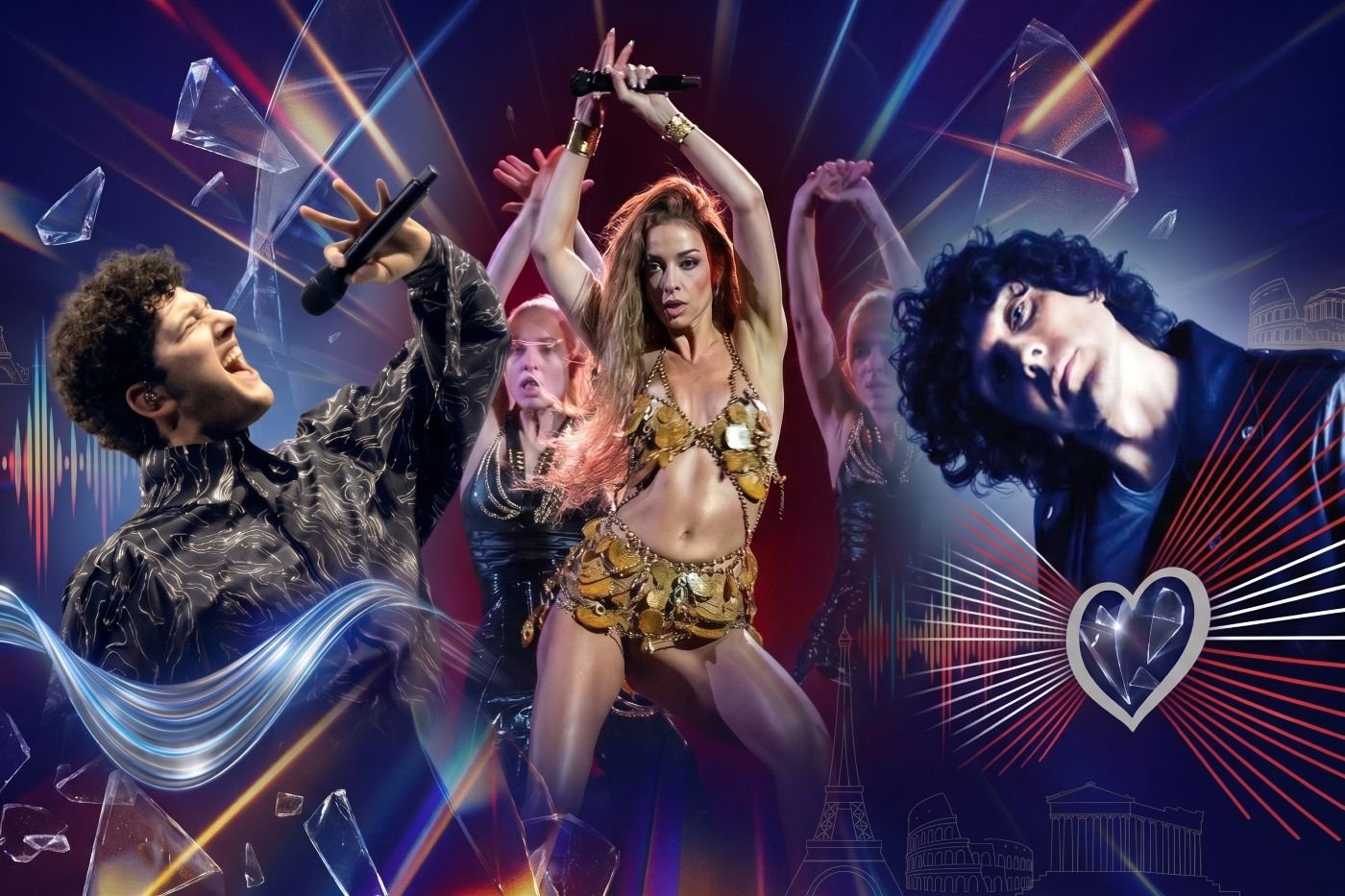
Among the Albanian diaspora who did not represent Albania at the Eurovision Song Contest, two have achieved top 3 placements. Eleni Foureira (born Entela Fureraj) represented Cyprus (effectively the extended Greek market) in 2018, while Gjon Muharremaj (stage name Gjon’s Tears) represented Switzerland in 2021 (and co-penned his would-be 2020 song «Répondez-moi»). But the two have taken vastly different paths in relation to their Albanian heritage and presentations within, which will illuminate the path of discussion for this article.
Let’s start with Gjon. Muharremaj’s music has largely stayed Francophone, but his artist name directly evokes memories of his grandfather’s first reaction when he sang “Can’t Help Falling in Love with You”, his grandfather’s favorite song. His Eurovision artist profile also mentions a third-place finish in Albania’s Got Talent at the age of 12 (2011), followed by a semi-final finish in Switzerland’s Got Talent the year after and a similar semi-final finish in The Voice France in 2019. Through all of this, Muharremaj has used his vocal platform as a means to “move people in all sorts of ways, whether it’s joy, sadness or melancholy”.[2] But for all his intracontinental success and second-generation immigrant status, he still has found ways to maintain musical connections with his Albanian and Kosovar heritage: he sang Naim Gjoshi’s “Mora fjalë” at RTK concert “Rrno për me tregue”, which commemorated the 15th anniversary of Kosovar independence and 25th anniversary of UÇK action.[3] Muharremaj also featured on Adelina Thaqi’s 2025 song “Orët e fundit”.[4]
Eleni Foureira has stood as a stark contrast with Muharremaj in almost every way. Her Eurovision profile mentioned her birth in Albania but immediately continued to her music career’s commencement in 2010.[5] According to a quick Wikipedia search of song credits, Greek writers/producers and Vouliagmeni-based Panik Entertainment Group helped create her musical brand, though she has started to earn songwriting credits since her Gypsy Woman EP released in 2019.[6] Foureira also highlighted that she once felt ashamed for being Albanian when she was bullied by peers in Greek schools, but she would not back down 20 years later from a marked shenja e flamurit with Albanian representative Eugent Bushpepa (“Mall”, Fest56).[7] And Foureira would perform in Tirana at Fest58, after she had expressed open support for the eventual runner-up, Elvana Gjata, both on social media and during the broadcast.[8] The broadcast stream no longer exists, as RTSH’s original YouTube channel was terminated due to copyright strikes, also mentioned in my initial article.
Diaspora relations with their land(s) of heritage may be complex, to say the least. For many refugees whose countries of refuge have expected more assimilation and integration from the newcomers, systematic discrimination may contribute directly to worse outcomes. In Malmö, the third-largest Swedish city which houses a large Muslim refugee population from several conflicts in the Middle East, said Muslims are not given any representation in hospital meetings.[9] The act of being displaced from the land of one’s own culture may sometimes lead to poor mental health outcomes and risks to cultural identity, sometimes even shame from older heritage wielders for having adapted away from the “purity” of the home language, culture, and identity.[10],[11] Even Switzerland, noted by the Migration Policy Institute, is not immune to bouts of non-neutrality when it comes to immigrants. While Switzerland rejected a 2026 “sustainability” initiative to cap the population at 10 million, the dynamic between skills shortages and greater European dialogue has politicized the plight of the roughly 40% of Swiss residents with some form of immigration background.[12],[13]
With the two different Albanian diaspora musicians mentioned, we have seen wildly different attitudes toward language use and even the focus markets. For Eleni, her Albanian language and identity were not safe to exist openly until she was old enough and safe enough to understand and be proud of her heritage. This earned safety comes in two parts: physical unsafety in Albania, as well as socioeconomic unsafety in Greece.
Foureira was born in Fier between the death of Enver Hoxha and the nominal end of one-party rule, but her family fled the general unrest which was to follow in the 1990s. According to a 2021 interview on ΕΝΩΠΙΟΣ ΕΝΩΠΙΩ (Enopios Enopio – Face to Face), she fled with her family between when she was 8-10 years old following the collapse of the pyramid schemes in 1997.[14] Albania was therefore not physically safe for her family, even when she left Fier in a taxi in tears.
But if she had found relative physical safety in migration to Greece, she could not guarantee her social safety në shqip. The same interview mentioned that she felt a need to hide her Albanian origins to avoid peer judgment. And so, three things stand out:
- On being from Albania: outside of the bullying noted earlier in the article, Foureira first made several denials of her origins after moving, claiming Brazilian and then Mexican heritage, but she is nevertheless proud of Albania.[15]
- On Greece: Quoting Foureira upon finding out that her DNA test returned 68.9% Greek and South Italian heritage according to former Eurovision sponsor MyHeritage: “I’m not Greek — I just grew up [there]. But I feel Greek because I have the same mentality.”[16] Interestingly, 63.6% of Albanian DNA collected by MyHeritage shared this part of their genetic origin, while Foureira also was tested as having 29.8% DNA from the Balkans.[17]
- On Albanian language usage: from my memories of the Fest58 speech Foureira made following her long performance segment, her Albanian language usage was rather broken and punctuated by bouts of English or rehearsed phrases (and segments of Albanian folk songs). Unfortunately, the full final night stream was removed, along with RTSH’s original YouTube channel, back in 2019. (I found a mid-2018 interview on the inaugural episode of Jonida Shehu’s podcast, Jonida Podcast, which seems to support claims about language use.[18])
Foureira’s professional reliance on Greek producers and her passive Albanian language skills likely suggest her linguistic choices may directly map to her life. As digital journalist Sophia Smith Galer wrote in her book How to Kill a Language, cultural loss often carries a complex sense of shame when interacting with one’s heritage. This shame has driven diaspora members to channel belonging into different markers of identity: appearance, cultural traditions, and upbringing, among others.[19] As for safety, her social and vocational stability have carried her away from overt Albanian musical pride, instead favoring the spices of Greek musical safety.
I see some of these same patterns in my own life. Living in a community increasingly shaped by tech-driven first-generation immigration, I have watched the church cliques of my childhood migrate to secular third spaces. In packed Chinese restaurants, I have sat alone while groups of families, friends, or coworkers chatted in Mandarin, in conversations I could understand but was neither welcome nor motivated to join. I was playing a perpetual third wheel to my parents’ community dynamics, where my own needs were lost in translation across two cultures, gender lines, and then-undiagnosed neurodivergence despite their efforts. It is this specific, baffling shade of “otheredness” that children of authoritarian diasporas learn to navigate on their own terms, one word and one world at a time.
The In-Between Case: «Stella Stellina» and Ermal Meta
The previous section only covered Albanians who had reached the top 3 during their respective Eurovision years. Expansion into the top 5 introduces an enigmatic figure who has achieved great successes in music abroad, who also maintains a delightfully complex relationship with the homeland. I am, of course, speaking of Ermal Meta, who with Fabrizio Moro represented Italy with the Sanremo-winning «Non mi avete fatto niente» in 2018. He would later visit Fest57 as a guest.[20]
Earlier this calendar year, Meta performed his new song «Stella Stellina» as part of Festival di Sanremo and eventually received an 8th-place finish. While his song from 8 years ago explored the defiance of human will and compassion against inhumane bloodshed and destruction, «Stella Stellina» painted a haunting tale of a girl from Gaza who perished in the ongoing humanitarian catastrophe.[21] Along with songwriter Gianni Pollex and songwriter/producer Dardust, Meta carved a haunting story out of the first two lines of the eponymous Italian nursery rhyme.
The song starts with a chorus. The stable handclaps, which highlight the tresillo rhythm with extra steps, welcome Meta’s G# minor melody. Tender mandolin tremolo picking joins, then slow, mournful strings join from below about halfway through the first chorus. As the chorus ends, a programmed plucked instrument transitions the listener into the verse, along with vaguely ethnic percussion. While the sounds have been “corrected” for Western intonation (senses of pitch), the underlying modes and relevant articulations echo former Ottoman influence and have been common within Balkan and greater Mediterranean folk traditions. The makams (Turkish modes) in Ottoman music are of slightly different flavors than those of Arabic groups, including Palestinians.[22] But in this song, the Arabic-adjacent tonality is used as a bridge to a ravaged world.
The first verse only begins to pick through the ruins of the loss through memories. The occasional bass drum, auxiliary percussion, and percussive bass synth act as a steady pulse in an otherwise sparse setting, with small melodic instruments dropping in occasionally during the second half of the verse.
If the sparseness of the first verse allowed for the exploration of loss, the return of the familiar chorus brings with it greater weight, measured by the doubled bass drum cadence and additional instruments. The bass drum rhythm now pushes a familiar reggaeton groove, but unlike the usual mixes found in Puerto Rican or Albanian reggaeton, the bass drum is not automatically doubled with closed hi-hat cymbals. Instead, a subdued tambourine-like sound seems to play sixteenth notes on all but the first beat of each measure. Unlike the reggaeton parties which kept me up some nights of the December Festivals, the dark, subdued approach to everything sounds more like an offering for the senseless dead, especially in light of the almost haunted single-note synthesizers, wobbling like ghostly presences most present in the bridge (“Fiori in un cortile con le pietre intorno…”). And so, with lyrics he penned himself, Meta crafted a relatable story of loss across continents and landed in a respectable eighth place.
During the Sanremo season, Italian Deputy Prime Minister Matteo Salvini decided to compliment Meta’s grasp of the Italian language:
Faccio i miei complimenti a Ermal Meta ed al suo perfetto utilizzo della lingua italiana. In Italia vivono e lavorano milioni di donne e uomini nati in un Paese straniero e perfettamente integrati nella nostra società, per me sono preziosi e benvenuti. Io contrasto da sempre clandestini e delinquenti, e sono sicuro che anche Ermal Meta condivide questo mio pensiero. Un abbraccio al fiero popolo albanese, viva Sanremo, la lingua e la musica italiana!
(I offer my compliments to Ermal Meta and to his perfect use of the Italian language. In Italy, millions of women and men born in foreign countries live and work and are perfectly integrated into our society. To me, they are precious and welcome. I have always opposed illegal immigrants and criminals, and I am sure that Ermal Meta shares this view of mine as well. A warm hug to the proud Albanian people. Long live Sanremo, the Italian language, and Italian music!)[23]
How very interesting, the wording of this “compliment”, when compared to the realities of being a 1.5-generation immigrant: old enough to remember significant amounts of Albanian language and cultural artifacts, but young enough to quickly adapt to the language and social setting. The nominalized word “integration” is also pushing quite a bit of weight here, and I would like to compare it to the word “assimilation”, which seems closer to what Salvini insinuated.
Assimilation in context, according to Cambridge’s dictionary, may mean the following:
- (1) the process of becoming a part, or making someone become a part, of a group, country, society, etc.; and
- (4) the process of becoming similar to others by taking in and using their customs and culture.[24]
Integration, according to the same dictionary, may mean the following in context:
- (1) the action or process of successfully joining or mixing with a different group of people;
- (2) the action or process of combining two or more things in an effective way; and
- (5) the process of becoming part of a group of people.[25]
The fifth definition of integration is effectively the same as the first definition of assimilation. But this conflated definition has become the crux of anti-immigration politics. See, for example, the center-right Swedish Government Office’s official position on “integration”:
Integration policy is based on the premise that foreign-born women and men should have the same obligations, rights and opportunities as the rest of the population to live their lives in society in freedom, dignity and independence. General measures are required in many different areas, including the labour market and education and training, to achieve this goal. These are supplemented with targeted language, labour market and education and training measures, for example. Certain newly arrived immigrants also have the possibility of participating in the Swedish Public Employment Service’s introduction programme. The area also covers compensation to municipalities and regions for the reception of refugees.[26]
The policy looks reasonable on paper; in practice, however, it leads to a tokenism like that used by Salvini in his quote. Salvini has made a virtue of “perfect use of the Italian language” while reviling and manufacturing “illegal immigrants and criminals”, given that Salvini has attempted to criminalize NGO rescue ships and decried the European Court of Justice’s 2025 ruling which stopped Italy’s plan to use Albania regarding the attempted refugee processing camps in Shëngjin and Gjadër.[27],[28],[29] Furthermore, Salvini’s praise of Meta made no attempt to acknowledge anything but the work (obligations) these token immigrants have done to economically and culturally assimilate into the host culture (maybe their ethnic pride), instead opting to praise Italy and its institutional greatness. Despite written policies like the current Swedish government’s, assimilation usually comes with the erasure or dismissal of one’s cultural heritage in favor of the host culture. In other words: when in Rome, do as the Romans do. Those with power have demanded conformity to what suits the sensibilities of those in power; that is to say, they have demanded assimilation.
It is perhaps in this alienated light where Meta said, “Quando cambi luoghi, la nuova terra cambia il nutrimento. Inizialmente ho dovuto abituarmi, e mi sentivo straniero qua e là… Sei in una condizione che somiglia a una diserzione costante” (When you change places, the new land changes your nourishment. At first, I had to get used to it, and I felt like a stranger here and there… You are in a condition that resembles constant desertion).[30] There are parts from the heritage culture which may not match the analogue of a home culture, which may make people stand out in conversation. And forced assimilation may feel incongruent with one’s own being. But, as the Oculus News coverage of the Meta-Salvini discourse points out: “cultural integration does not require erasing one’s roots. It can mean enriching a new homeland with the depth of one’s heritage” (emphasis mine).[31] And it is in the acceptance and respect of seemingly constant contradictions where one integrates: not just among groups of different people, but also within oneself, to gain a voice which has found safety and to advocate for those who have yet to find that voice for themselves.
© 2026 Jessie Hong. All rights reserved.
[1] https://peizazhe.com/2020/01/12/festivali-i-kenges-a-vision-for-the-musical-trajectory-of-albania/
[2] https://www.eurovision.com/eurovision-song-contest/rotterdam-2021/participants/gjons-tears-1/
Muharremaj’s performances during the Albanian talent show were featured on Telegrafi as he was going through The Voice of France process in 2019: https://telegrafi.com/gjon-muharremaj-shqiptari-qe-befasoi-jurine-e-voice-ne-france-zerin-e-tij/.
[3] Mora fjalë: https://youtu.be/EU7AW2wJD-A
[4] Orët e fundit: https://youtu.be/pae5UyKwNs8
[5] https://www.eurovision.com/eurovision-song-contest/lisbon-2018/participants/eleni-foureira-1/
[6] https://www.discogs.com/release/13704339-Eleni-Foureira-Gypsy-Woman
[7] https://www.balkanweb.com/en/Eleni-Foureira-lashes-out-at-racist-Greeks-who-once-made-her-feel-ashamed/
[8] https://www.balkanweb.com/eleni-foureira-ka-nje-kengetare-te-preferuar-ne-festivalin-e-rtsh-se-e-tregon-publikisht-foto/
[9] https://integrationsforum.se/antimuslimsk-rasism-utmaningar-och-samhallets-ansvar/ (Swedish. See the bullet point regarding “structural racism”, which in Swedish is a cognate)
[10] https://pmc.ncbi.nlm.nih.gov/articles/PMC1414713/
[11] https://www.latinopublicpolicy.org/2023/11/language-induces-an-identity-crisis-for-the-children-and-grandchildren-of-latino-immigrants/
[12] https://www.admin.ch/en/sustainability-initiative
[13] https://www.migrationpolicy.org/journal/country-profile/switzerland-comes-terms-being-country-immigration
[14] https://youtu.be/Dpi1oAlYsCI (Greek)
[15] https://www.reddit.com/r/eurovision/s/LjdOCJ2boh
[16] https://youtu.be/1Vfe0cMTuLI
[17] https://www.myheritage.com/wiki/Greek_and_South_Italian_ethnicity
[18] https://youtu.be/fg6X7thVqaw
[19] https://youtube.com/shorts/tmuCMptkaA8
[20] https://youtu.be/H8DHMSJ5Wzw
[21] https://www.deejay.it/articoli/ermal-meta-stella-stellina-testo-significato/ (Italian)
[22] https://web.archive.org/web/20061215165158/http://www.turkmusikisi.com/osmanli_musikisi/the_ottoman_music.htm
[23] https://www.repubblica.it/spettacoli/dossier/festival-di-sanremo/2026/02/27/news/salvini_gaffe_su_ermal_meta_chi_si_integra_e_benvenuto_lui_la_bestemmia_e_silenzio_su_gaza-425187760/ (Italian). Emphasis mine.
[24] https://dictionary.cambridge.org/dictionary/english/assimilation
[25] https://dictionary.cambridge.org/dictionary/english/integration
[26] https://www.government.se/government-policy/integration/
[27] https://yris.yira.org/winter-issue/anti-immigrant-populism-in-italy-an-analysis-of-matteo-salvinis-strategy-to-push-italys-immigration-policy-to-the-far-right/
[28] https://video.corriere.it/politica/migranti-salvini-sentenza-vergognosa-non-ci-arrendiamo-a-porte-aperte-clandestini/c36b19d8-9f19-498d-8c04-fd6684248xlk (Italian)
[29] https://www.globaldetentionproject.org/european-court-ruling-challenges-italy-albania-detention-deal-and-other-externalisation-plans
[30] https://www.repubblica.it/spettacoli/dossier/festival-di-sanremo/2026/02/27/news/salvini_gaffe_su_ermal_meta_chi_si_integra_e_benvenuto_lui_la_bestemmia_e_silenzio_su_gaza-425187760/
[31] https://www.ocnal.com/2026/02/ermal-meta-between-two-identities.html
Discover more from Peizazhe të fjalës
Subscribe to get the latest posts sent to your email.