The date was Friday, April 20, 1928. The time was 15:30. The place was the elegant Sculpture Hall at the Brooklyn Museum in New York City. The occasion was an Albanian Costumes Exhibition, displaying the collection of a young American diplomat, John Hamlin.
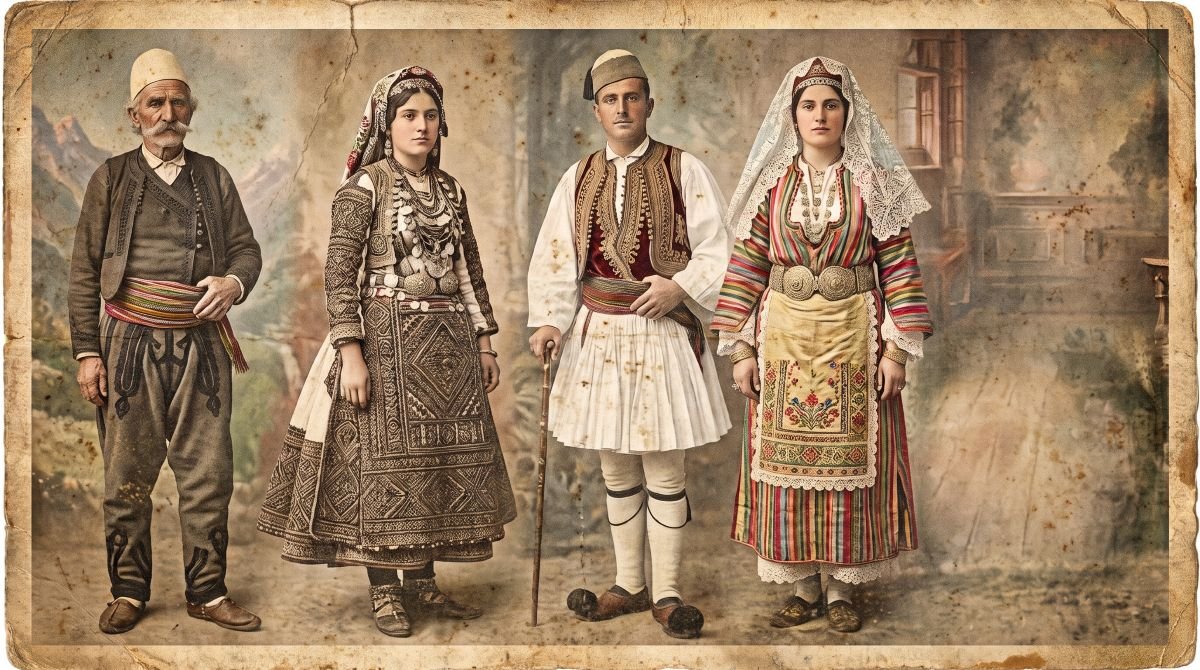
The picturesque Albanian national dress captivated many, including Lord Byron, and was documented in scholarly works and paintings by foreign travelers and artists who journeyed the region
But this was the first time ever that Albanian costumes would be publicly exhibited in a showing of such substance and magnitude.
Faik Konitza, the Minister of the Albanian Republic in the U.S. was to deliver the keynote speech. He would be followed by the magic flute of Thoma Nassi performing traditional Albanian music.
Concise, brief, to the point, in a little more than four typewritten pages, Konitza’s speech was a true masterpiece, delivered in a brilliant rendition. The New York Times published its key points the following day.
In these pages we have offered a very rare videoclip of Konitza during King Zog sisters’ visit in America in 1938, or ten years after the Brooklyn Museum Exhibition.[1]
Also in these pages we have published the audio recording – and transcript – of Noli’s famous speech on Albania’s 50th Anniversary of Independence at Anthony’s Pier 4 in Boston, on November 28, 1962.[2]
We asked then hypothetically whether Fan S. Noli would have preferred to publish his speech at Peizazhe të Fjalës. We are also presenting here, for the first time in English, Konitza’s famous speech, made available courtesy of the Brooklyn Museum Archives. [3] An Afterword will follow.
Agron Alibali
The COLOR OF OLD ALBANIA[4]
By Faik Konitza
Mr. Chairman, Ladies and Gentlemen:
It is indeed an honor to be received so kindly at this splendid institution and to address such a distinguished audience, and I am truly grateful to the President and the Trustees for having given me this opportunity.
Though I shall speak mainly about the Albanian costume, it is perhaps appropriate by way of introduction to say a few words about Albania in general.
Albania is one of the few countries that have achieved Statehood and national independence in the last fifteen years. But though a new State, Albania is a very old nation. Her present name dates from the Middle Ages. The student will recognize her more easily in the past under her antique appellation of Illyria. This obsolete name struck the mighty fancy of Shakespeare, but unfortunately the real Illyria was not the charming Illyria of “The Twelfth Night”;— it was the Illyria of grim battlefields where Caesar and Pompey, Octavian and Marc Anthony fought out the destiny of the Roman Empire; it was also the Illyria that gave birth to such tremendous personalities as the Emperors Diocletian, Constantine the Great, and Julian the Philosopher. Most of our towns have the respectable age of two thousand years and over: Durazzo is known to have been founded in the seventh century before Christ, and Scutari probably is even older. Two archeological missions, one French, the other Italian, have received from the Albanian Government the authorization to excavate; in a short period these missions have already succeeded in making a few interesting discoveries, and it is hoped that in due time they will throw more light on the ancient history of the country.
In spite of wars, invasions, and continuous unrest all along its past, — the Albanian people, by its tenacity and its power of resistance, has been able to keep alive not only its distinct language, recognized by philologists as the oldest in South-Eastern Europe, but also some of its antique traditions. One of these is the national costume. Baron Francis Nopcsa, a well-known authority, in one of his recent books on Albania, published three years ago in Germany, has published side by side two illustrations, one of a present-day Albanian costume and the other of a prehistoric image excavated in a former Illyrian region; the similarity of character is striking.
When one speaks of Albanian costume, an explanation is necessary. The Albanian people is too individualistic to have a uniform dress. There are in fact as many Albanian costumes as there are different regions in Albania. But above this local diversity, there has always been a certain dress general in its characteristics which might justly be called the national costume. The cloak, among others, used to have in its form a certain similarity all over the country; and the white kilt was, within living memory, part of the gala dress of every gentleman in both Northern and Southern Albania. The fact that similar styles of dress are to be found in neighboring countries means nothing more than the strong influence exercised in the past by the Albanians upon the nationalities around. For instance, it has repeatedly been pointed out by students of the subject that the so-called modern “Greek” costume is in reality a debased imitation of the Albanian costume. It has been introduced among the Greeks in the fourteenth century when the Albanians under Bua Spata invaded and conquered Greece.
One cannot speak of the Albanian costume without mentioning Lord Byron. There are several portraits of the poet in Albanian costume. The best known are one owned by the family of Murray, the English publisher, and another exhibited in the National Portrait Gallery in London.
In the thirteen volumes edition of Byron’s complete works and letters published a quarter of a century ago by Murray, there are many references to the Albanian costume. The oft quoted lines from “Childe Harold’s Pilgrimage” are well-known:
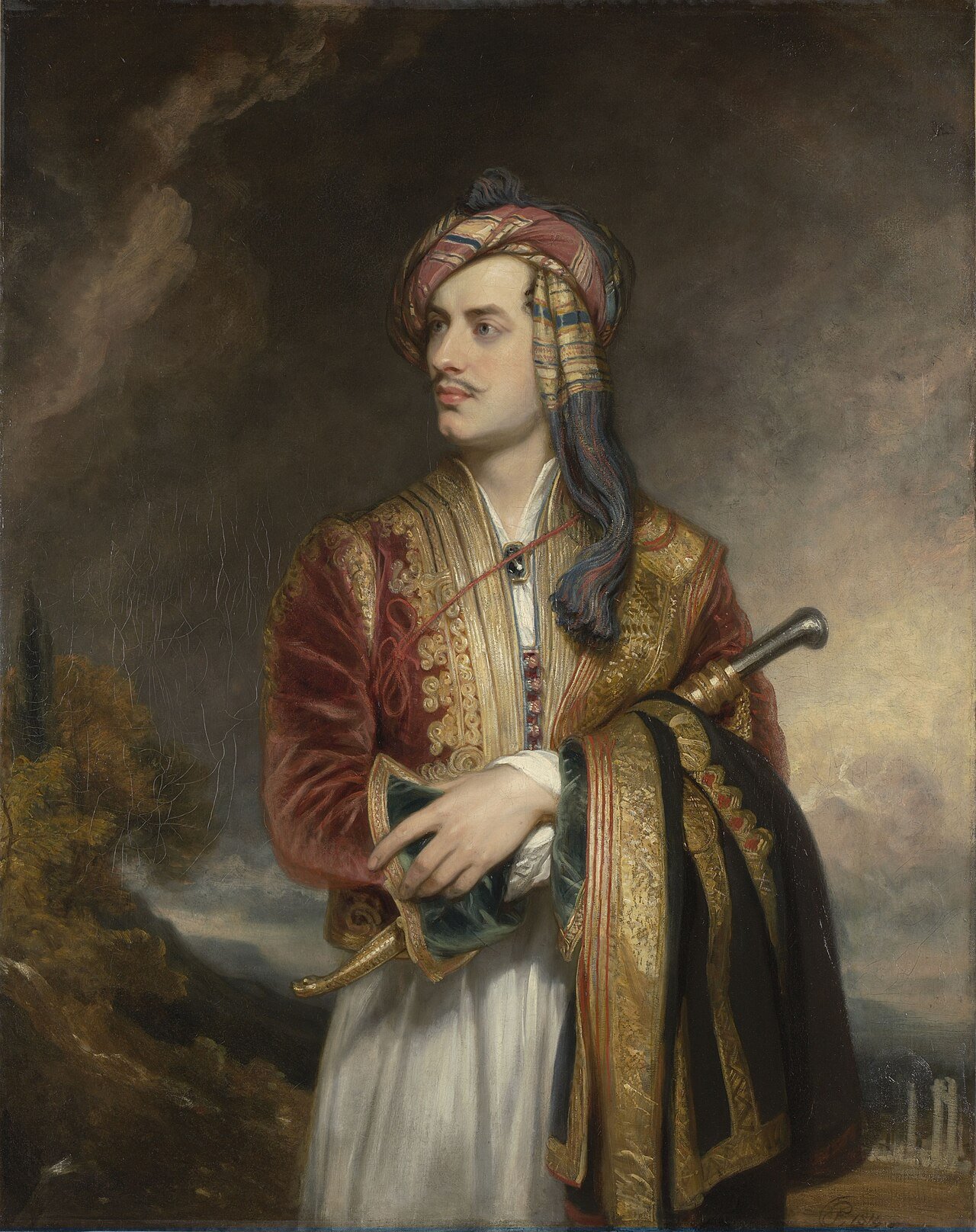
By Thomas Phillips – Government Art Collection, Public Domain, https://commons.wikimedia.org/w/index.php?curid=45367891
“The wild Albanian kirtled to his knee,
With Shawl-girt head and ornamented gun,
And gold-embroidered garments, fair to see.”[5]
At the beginning of the nineteenth century, Byron visited Albania, in spite of the warnings of Shelley who feared the dangers of an unknown country. In a letter written from Albania to his mother and dated November 12, 1809, among other things Byron says:
“I shall never forget the singular scene on entering the Tepeleni at five in the afternoon, as the sun was going down. It brought to my mind (with some change of dress however) Scott’s description of Branksome Castle, in his Lay of the Last Minstrel, and the feudal system. The Albanians, in their dresses, the most magnificent in the world, consisting of a long white kilt, gold-worked cloak, crimson velvet gold-laced jacket and waistcoat, silver-mounted pistols and daggers…….formed a new and delightful spectacle to a stranger.”[6]
Byron was a keen observer. In his notes to “Childe Harold” he makes an interesting remark on the effect of the style of dress upon the manner of walking:
“The Albanians in general have a fine cast of countenance…
Their manner of walking is truly theatrical; but this strut is probably the effect of the capote, or cloak, depending from one shoulder.”[7]
Another passage from a letter to his mother is interesting: “I have,” says Byron, “some very ‘magnifiques’ Albanian dresses, the only expensive articles in this country. They cost fifty guineas each, and have so much gold, they would cost in England two hundred.” [8]
This expensiveness, noted by Byron, is one of the causes of the gradual disappearance of the national costume in Albania. But there is perhaps a more important cause: the tendency towards standardization and sameness that has become the world over one of the sad characteristics of our time. It is curious to see how generally and absurdly uniformity is identified with civilization and how colorful variety of manners and dress is fought against in the name of progress. I for one cannot help deploring this modern mania when I recall memories of my boyhood, when still very often I used to witness beautiful pageants like the one described by Lord Byron in the letter to his mother that I have quoted.
President Zogu, the youthful and marvelously able leader of Albania, has tried now and then to save some of the color of Old Albania. But in Albania as everywhere else in the world the tendency is irresistibly towards uniformity. That is why institutions like the Brooklyn Museum are so fine and so necessary. They are the archives of the imagination and beautiful diversity of the race, and countries of the world. I remember with grateful enchantment one hour that I passed here a few months ago under the guidance of Mr. Stewart Culin, the scholarly keeper of these treasures of the past. Some day in the future, when all human beings under the sun will be dressed like undertakers, poets and dreamers will come here to relax in the study of the past and to meditate.
AFTERWORD
by Agron Alibali
An American diplomat and collector
The idea of an Albanian Costume Exhibition in New York is credited to John Nellis Hamlin [1895 – 1969]. The young American diplomat from Oregon had just graduated from Harvard in May 1923 and was dispatched to Tirana, Albania, in December of 1924. The reader will recall that around that time the ephemeral government of Bishop Fan S. Noli was overthrown by Ahmet Zogu.
Hamlin served in Tirana till June 1926. He must have learned of Lord Byron and Albanian folk costumes in school. It is also probable that, during the exercise of his diplomatic duties, he saw around the country the famous Albanian National Dress.
Charge d’Affaires at the American Legation in Tirana at the time was John Trojan Kodding [1899 – 1933], a brillian young diplomat. On June 30, 1925 Kodding sent a confidential report to the U.S. Secretary of State. Kodding reported of a General Assembly [Kuvend] convened by Ahmet Zogu on June 27, 1925, with about five hundred “chieftains” of Albania’s Northern tribes, and members of his government, held at “the Moslem praying field in Tirana”, or Namazgah. It is very likely that Kodding and Hamlin were present as observers. Later on this historical Kuvend was vividly described by Eqrem bey Vlora as well, in his famous Memoirs. As both sources confirm, after Zogu’s address, the chieftains gave him the “besa” to maintain peace and order in their regions.
In describing the deliberations, Koddings must have been deeply impressed by the way the assemblymen were dressed, noting in his diplomatic report of “a chief. who like all of his fraternity, was arrrayd in gilt and silver tribal costume…” [NARA, DOS Records on Internal Affairs of Albania (875.00/199)].
It is very likely that this unique experience must have captivated Hamlin, leading him to collect the twelve precious Albanian costumes.
Two years later, in September 1927, while Hamlin was serving in Spain, he floated to the Brooklyn Museum the idea of exhibiting his Albanian costumes. He personally showed two costumes to Stewart Culin [1858 – 1929][9], the experienced curator, who immediately noticed their worth.
“Two of these costumes, which he brought, are of great distinction and value”, Culin wrote.
But it is his other comments that are particularly revealing, and in a sense, dramatic.
No costumes left in Albania?
“Mr. Hamlin’s costumes are valued at over $500 a piece”,[10] Culin observed.
And then he notes: “There are none left in Albania, and I know none in the United States except as our own. We have two of similar quality and many others of less importance”.[11]
Culin was very knowledgeable of national costumes of Eastern Europe. He had researched and published on costumes of that region of Europe before.[12] What was Culin referring to with respect to the Albanian national dress? And was his statement accurate?
There must have been a clear distinction in Albanian costumes look and quality. First, there were costumes used in special occasions, or dressed by the country’s upper class or elite. In this category was the one worn by Lord Byron, as painted by Tomas Phillips in 1813, or the costumes of sisters Kaliopi and Elena Bonatti in Shkodra in October 1848, as represented by Edward Lear.[13] And, second, those of everyday use, sported by the general populace.
In 1930 circa, Ahmet Zogu, now the King, together with his family, posed[14] all dressed up in Albanian National Costumes, which look particularly distinct. The King was wearing the fustanella![15]Konitza referred in his speech to, “President Zogu, the youthful and marvelously able leader of Albania, [who] has tried now and then to save some of the color of Old Albania.”
King Zog’s photo with the fustanella appeared quite fitting of the color and charm of Old Albania.
In February 1931, the distinguished National Geographic Magazine published an entire article on Albania. It included about a dozen-colored photos of Albanian men and women dressed in their national dress.[16] Those costumes most likely belonged to the second category.
That everyday Albanian national costumes were manufactured and used till late is a fact. In 1954 Sergei Youtkevitch, the world-famous cinema director of the movie “Scanderbeg” remarked that he was glad to witness in the country the antique atmosphere and flavor of Old Albania from the time of Scanderbeg.[17]
Therefore, Culin’s “there are none left” comment, was certainly referring to the first category: those Albanian costumes of particular distinction, elegance and beauty, dressed by the upper class. They clearly were becoming very rare and thus were slowly disappearing.
Culin was much more direct and sincere with his close protégé, Morris D.C. Crawford.[18] “The costumes are beautiful beyond words” – he wrote.
And in a reference to efforts of the American fashion industry of the time to draw trends, colors and designs from traditional dresses of different nations, he wrote to Crawford that “Albanian costumes have not been exploited. There is nothing in print about them in English”.
Expressing his expert, candid opinion, Culin concluded something that Konitza said out loud in his speech four days later: “It was the costume Lord Byron wore when he went to fight for Greece, the “Greek” costume being really Albanian.”[19]
Enters Faik Konitza
Hamlin entertained his Albanian Costumes idea to Culin in September 1927. On October 20, 1927 Culin invited Faik Konitza “to deliver the address”. Hamlin had also suggested to have Thoma Nassi [1892 – 1964] perform a “concert of Albanian music”. “No offer will be spared to give distinction to the occasion”, wrote Culin.[20]
We can only imagine Konitza’s reaction. An event about the Albanian heritage and culture in New York City!
The idea certainly touched Konitza’s deepest cords. Since his boyhood Faik was imbued with the Albanian national dress. He had read about Lord Byron’s love of the Albanians and their national costumes. He wrote about Lord Byron in Albania in a remarkable article in French, published in the very first issue of Albania magazine. [La Revue Albanaise, 25 Mars1897, 1/1, p. A-11]. When he first arrived in the U.S., Konitza was wearing the fustanella. And Konitza knew well the work of Nopcsa and other scholars on Albanian national costumes.
On November 7, 1927 Konitza called and “expressed his approval…and willingness to cooperate”.[21]But November and December was a busy time in Washington. He asked for a postponement.
The date was finally set for April 20, 1928.
Meanwhile Konitza got in touch with Thoma Nassi in Brockton, MA, in order to prepare for the big day.
Sometimes between end of February – mid March 1928 Konitza sent to Culin a handwritten letter:
“I have very often thought about your project of an exhibition of Albanian costumes, with a brief talk on my part, and a concert of Albanian folk music. That I have thought about it seriously I will give you one proof: I came to Boston about one week ago mainly to arrange with Professor Nassi about the program of the concert. He has an album of about thirty inedite folk songs and tunes: of these we selected ten or twelve, which could be performed on the flute in about 30 minutes. Mr. Nassi is hard at work, writing for these popular airs an accompaniment that will be in keeping with their style and spirit and will rather bring out their quaintness than hide it.
This will be the concert of Albanian music that has ever been [performed in] a country outside [of Albania].”[22]
Meanwhile Konitza started working on his speech. Unsurprisingly, as of Monday April, 16, 1928 the speech was not done. “The 20 minutes little speech that I intend to deliver is unfortunately not yet ready, but I hope to be able to mail it to you upon my arrival in New York”, he wrote to Culin.[23] As a true perfectionist, he was never happy until his work was flawless.
Meanwhile Nassi had made all his arrangements. He would arrive in New York one day early, thus having sufficient time for final rehearsals.
Exhibition Day
April 20, 1928. The Exhibition of Albanian Costume, “the most magnificent in the world” as Lord Byron put it, was formally opened at the Brooklyn Museum.
The exhibition “consisted of fifty costumes, twelve of which were lent by John Hamlin, Secretary of the American Legation at Madrid, and the rest were from the Museum’s collection, several of which were recent acquisitions and were on view for the first time”.[24]
Mr. Frank L. Babbott, President of the Board of Trustees of the Brooklyn Institute of Arts and Sciences opened the formal ceremony and introduced the Minister of the Albanian Republic to the U.S.[25]
Faik Konitza thought his four-page speech would be twenty minutes long. It lasted no longer than ten. Typical of his style and brevity, it was delivered with elegance, clarity and substance.
Konitza captivated the audience. Through Childe Harolde verses, through Letters to Mother, in a sense Konitza brought Lord Byron inside the Brooklyn Museum.
In his speech Faik reminisced his time as a young boy in the town of Konitza, remarked on the imposed uniformity of outfits in modern times, combined with the gradual disappearance of national dresses. Konitza ended with the metaphor of the lonely poet meditating such lost heritage at museums like Brooklyn.
Konitza spoke also of the fustanella and its later adoption in Greece. In all fairness, neither Konitza nor Culin were the first to discover such adoption in usage.
George Finlay, the prominent historian of the Greek Revolution was among the first to notice it. “It was the fame of the Albanians…which induced the modern Greeks to adopt the Albanian as their national costume”, he wrote in bis famous History of Greece.
Without mincing words, Finlay concluded: “It is the consequence of this admiration of Albanianism that the court of King Otho assumes its melo-dramatic aspect, and glitters in tawdry tinsel mimicry of the rich and splendid garb which arrested the attention of Childe Harold in the galleries of the palace of Tepelen; but the calico fustanella hangs round the legs of the Greeks like a paper petticoat, while the white kilt of the Tosk, formed of a strong product of native looms, fell in the graceful folds of antique drapery”.[26]
While the audience was still absorbing Konitza’s remarks, Thoma Nassi’s flute followed with a live concerto of Albanian music. He was accompanied in piano by a Howard Layman.
The program included songs like The Nightingale, Awake My Love, You and I Alone, and dances like Beratçe, E Hequr, Gajde. It was perhaps the first ever Albanian music concerto in the United States, if not in the world.
Reverberations
The following day the New York Times published a long article with excerpts of Konitza’s speech. “Mr. Culin…was jubilant over the success of the afternoon”, wrote the Times correspondent.
Culin described the scene at the Museum as “a breath or romance, ‘without which museums would be unlivable’. Albania, he said, was one of the few countries in which romance remained alive, elsewhere it was preserved, as in museums”.[27]
Per diplomatic and social protocol, Konitza wrote a thank you note to Frank Babbott, Museum President “The function at the Brooklyn Museum was wonderful, and I only hope that everybody enjoyed it as much as I did”, expressed his sentiments Konitza.[28]
Babbott was very pleased, and told Culin that “everything went off so well it was worth whatever it cost”.[29]
Konitza wrote a personal and warm letter to Culin, as well. They had been working closely together for this unique project for the past eight months, and a sincere friendship had been struck between them.
A few days later, in May 1928 Konitza was back at the Mayflower Hotel in Washington, whereas Culin and his wife were set to travel on vacation to Hungary. Konitza was aware of this. “When you receive this note you probably have already packed up and will be feeling that curious fever of departure which is one of the charms of a journey”,[30] he wrote to Culin.
Since leaving behind his Mother and birthplace in Ottoman Albania, Konitza’s entire life had been a constant voyage, composed of thousands of journeys in two continents. Therefore he knew really well that particular feeling of “charm” …
The Korça native and talented musician Thoma Nassi, was also deeply impressed. “The happy hour I spent playing under those truly artistic surroundings will remain forever a sweet memory”, he wrote to Culin.[31]
Among the members of the New York elite attending the exhibition was also Mrs. Mildred Farwell, a journalist during WWI in the Balkans, a patron of the American Technical School in Tirana, supporter of excavations in Apollonia and a frequent visitor to Albania.[32]
Wife to a very wealthy American and friend of Konitza, Mrs. Farwell was so excited about the exhibition and concert that she wanted to organize an encore at her own elegant home in Long Island.[33]
“I enjoyed so much the exhibition at the Museum,” she wrote to Stewart Culin. “I thought it was quite extraordinary, the number of people who seemed to be interested in it, and it was, too, beautifully arranged and staged.”
In another comment, of relevance for the present time, Mrs. Farwell acutely remarked: “It seems to me that exhibitions of that sort are the most dignified and the most worth-while forms of propaganda for a country”.[34]
We do not know whether the exhibit and function were indeed repeated at Mrs. Farwell’s home. We have found no records of such an event at Konitza’s diplomatic archives in Rome.
In an ironic twist, John Hamlin was not present at the Exhibition. He had to return to his diplomatic post in Madrid in mid-December 1927.
Nevertheless, Hamlin was NOT the only and the last U.S. diplomat to fall in love with Albanian costumes.
In 1938 U.S. Minister to Tirana, Hugh Grant posed in a photo surrounded by several “Albanian ladies dressed in the national costumes they wore at the recent royal wedding of King Zog to the Countess Geraldine Apponyi.”[35] All those costumes most likely belonged to the first category.
And on the occasion of Albania’s 105th Independence, “U.S. Embassy personnel [in Tirana were] dressed in traditional folk costumes from all regions of Albania, highlighting Albanian craftsmanship, culture and art… Photos of the then U.S. Ambassador Donald Lu dressed in Albanian national costume were displayed at the Embassy’s social media accounts.[36]
As to the fate of John Hamlin’s twelve Albanian costumes we have no trace. But we do know that in 2009 the Brooklyn Museum donated all its collection of indumentaria to the New York Metropolitan Museum.[37]
A question comes to mind. Wouldn’t it be proper to revive the Brooklyn Museum historical event on its Centennial, on April 20, 2028, at the same place and in a manner that resembles as closely as possible the original Albanian Costume Exhibition? And to go one step further, why not revitalizing in toto et ad integrum the unique tradition of the making and wearing the Albanian National Dress?
Why Konitza’s speech was not published
Konitza superior knowledge of Albania’s folk costumes is well known. He wrote about them his Rock Garden. But the Albanian costumes were an essential part of his persona as well. As previously mentioned, Konitza first entered the U.S. dressed in a fustanella.
Approximately two years into his diplomatic service, Konitza now had the unique chance to present Albanians’ famous indumentaria[38] at a premiere American audience.
Culin told Konitza that his speech would be published at Brooklyn Museum’s Quarterly magazine, and obtained advance copies. “It is the desire of this Museum to print your address in its Quarterly and I shall be happy if you can give me a copy for this purpose…”[39]
Apparently Culin had more than one idea. One week later he wrote to his “most dedicated protégé”, Morris de Camp Crawford that Konitza would “speak on Albanian costumes, I trust and I shall try to get his remarks in typewriting for you.” [40]
On May 10, 1928 Konitza wrote to Culin that he decided to “leave [the] speech as it is, and to publish it unchanged”.[41]
For some reason, perhaps due to Culin’s Hungary trip, the speech was not included in the July 1928 issue of the Quarterly, and therefore, was never published.
Until today.
Agron Alibali
[1] Agron Alibali, Konica sikur i gjallë, Peizazhe të Fjalës, 17 qershor 2019, at https://peizazhe.com/2019/06/17/konica-sikur-i-gjalle/
[2] In two parts, on April 20, 2020, Agron Alibali, Fan S. Noli, “Nuk e shpikmë patriotizmën shqiptare, e gjetmë”, 1st part at https://peizazhe.com/2020/04/20/nuk-e-shpikme-patriotizmen-shqiptare-e-gjetme/ and on 13 March 2021, 2nd Part, at https://peizazhe.com/2020/04/20/nuk-e-shpikme-patriotizmen-shqiptare-e-gjetme/ at https://peizazhe.com/2021/03/13/nuk-e-shpikme-patriotizmen-shqiptare-e-gjetme-ii/
[3] The Albanian version of the Konitza’s speech on the Albanian Costumes was published in 2017, translated by this writer; see Agron Alibali, Faik Konitza, Dritëhijet e një Diplomati, Argeta, Tiranë, 2017.
[4] The Title is ours, as extracted from Konitza’s speech. Konitza’s speech is at Culin Archival Collection, Department of Ethnology [3.5.002]: exhibitions and installations, 1927-1928
[5] Lord Byron, The Works of Lord Byron, ed. Ernest Hartley Coleridge, vol. II (London: John Murray, 1899), p. 136, “Childe Harold’s Pilgrimage,” Canto II, stanza LVIII. Reference added.
[6] Lord Byron, “To Mrs. Byron, Prevesa, November 12, 1809,” Letter XL, in Thomas Moore, Letters and Journals of Lord Byron, vol. I (London: John Murray, 1830), 204–205. Reference added.
[7] Lord Byron, Childe Harold’s Pilgrimage: A Romaunt (London: John Murray, 1812), “Notes to the Second Canto.” Reference added.
[8] Lord Byron, letter to Mrs. Byron, Prevesa, 12 November 1809, in Byron’s Letters and Journals, ed. Rowland E. Prothero, vol. I (London: John Murray, 1898), p. 231. Reference added.
[9] Citing from his obituary: STEWART CULIN. Stewart Culin est mort le 9 avril 1929 à New York, où il était conservateur d’ethnographie au Brooklyn Museum depuis 1903. Son nom restera comme une des plus grandes autorités en ce qui concerne l’étude des jeux, tant en Amérique (American indian games, 1905) qu’en Chine, Corée, etc., etc. Il avait constitué des collections remarquables à l’Exposition de Chicago (1895), au U.S. Natio- nal Museum à Washington, au Museum de l’Université de Pennsylvanie à Phi- ladelphie (il avait dirigé ce dernier Musée pendant sept ans avec le plus grand succès) et enfin à Brooklyn. Partout, il avait mis ses connaissances à la dispo- sition de tous et exposé les matériaux recueillis suivant les méthodes les plus modernes. H. V.-B.” H. V.-B., “Stewart Culin,” Journal de la Société des Américanistes 21, no. 2 (1929): 410.
[10] $500 USD of October 1927 in September 2026 would be worth $9,625.86.
[11] Letter of Stewart Culin to Edward Blum, October 11, 1927, Culin Archival Collection, General correspondence [1.4.143] 10/1927. Emphasis added.
[12] Culin, Stewart. “Peasant Costumes and Textiles of Central and Eastern Europe.” The Brooklyn Museum Quarterly 8, no. 3 (July 1921): 69–77. Around that time, Ms. Blanche Paine [1897 – 1972], another American scholar, became deeply involved in Eastern European and Balkan Costumes. “Payne was truly a pioneer in the field of costume and apparel design, as she produced a seminal text on fashion history, “History of Costume” as well as an unpublished manuscript on folk costume from the former Yugoslavia.” At https://content.lib.washington.edu/payneweb/ Payne traveled to Albania in 1930s, and to Kosovo, Macedonia, Montenegro, and other republics of the gormer Yugoslavia after WWII. Her notes, collections of authentic dresses, photos, postcards are preserved at the University of Washington.
[13] Reproductions of Lear’s paintings of the Bonatti sisters and Abdullah Bey can be seen here: https://travellingalbania.com/edward-lear-shkodra/
[14] The photo was taken by Paul Popper, a well-known Czech journalist and photograph of the time, who moved in 1934 to London where he founded Popperphoto agency.
[15] King Zog I and members of the Albanian royal family outside the Royal Palace, Tirana, c. 1930–1934. Photograph by Paul Popper. Popperfoto, object J166965901; Getty Images, editorial no. 144365285. Published at the Christian Science Monitor, Boston, November 15, 1934, Photo of King Zog and his Family, clipping at Hugh Gladney Grant papers, 1847–1939, David M. Rubenstein Rare Book & Manuscript Library, Duke University.
[16] “Albania, Europe’s Newest Kingdom” by Melville Charter, Volume LIX (59), No. 2, February 193, p. 131.. https://tinyurl.com/yke2sw9t
[17] Youtkevith’s exact quoite is: “L’Albanie, ce pays fier et noble, a envore gardé, dans certains de ses regions non seulement les ancient châteaux, mais les costumes, et les coutumes nationales du temps du Scander Beg”. Serge Youtkevitch et Scander Beg, pars Georges Sadoul, Rendez Vous de Cannes 1954, Numero Special Quotidien, Dimanche 28 Mars 1954, 2 Anne, N. 4, Personal Archive AA.
[18] See infra note 13.
[19] Letter of Culin to Morris D.M. Crawford, April 16, 1928, Culin Archival Collection, General correspondence [1.4.156] 04/1928.
[20] Letter of Stewart Culin to Faik Konitza, October 20, 1927. Culin Archival Collection, Department of Ethnology [3.5.002]: exhibitions and installations, 1927-1928
[21] Letter of Stewart Culin to John Hamlin, November 7, 1927. Ibidem.
[22] Undated handwritten letter of Faik Konitza to Stewart Culin. Sent from the Ritz Carlton Hotel in Boston. Ibidem.
[23] Handwritten letter of Faik Konitza to Stewart Culin from the Legation of the Albanian Republic in Washington, April 16, 1928. Ibidem.
[24] Brooklyn Museum Quarterly, Volume 15, issue 3, July 1928, page 96. https://tinyurl.com/44b5e522
[25] Konitza was followed by Mr. Stewart Culin, Curator of the Department of Ethnology. After the speeches there was a program of Albanian music by Thomas Nassi, flutist and composer, and Howard Layman, pianist. Culin Archival Collection, Department of Ethnology [3.5.002]: exhibitions and installations, 1927-1928.
[26] George Finlay, A History of Greece from Its Conquest by the Romans to the Present Time, Greek revolution. Part 1: A. D. 1821- 1827 · Volume 6, p. 39 – 40.
[27] Albanian Costumes Shown at Museum, The New York Times, Saturday, April 21, 1928, Brooklyn Section. Ibidem.
[28] Letter of Faik Konitza to Frank L. Babbott, Esq., May 9th, 1928. Ibidem.
[29] Letter of Frank L. Babbott to Steward Culin, date unrecognizable, most likely end of April 1928, Culin Archival Collection, General correspondence [1.4.158] 05/1928.
[30] Handwritten letter of Konitza to Culin, May 10, 1928, Culin Archival Collection, Department of Ethnology [3.5.002]: exhibitions and installations, 1927-1928. The underlined words are in the original.
[31] Letter of Thomas Nassi to Culin, Brockton, MA, April 24, 1928. Ibidem.
[32] Joan Fultz Kontos, Red Cross–Black Eagle: A Biography of Albania’s American School, 1921–1933, pp. 131, 148.
[33] “The Minister tells me that you may want to repeat Mr. Nassi’s concert at your house. If you should do so, it will give me pleasure to send you Albanian costumes from the Museum, and flags I had made for our occasion.” Letter of Culin to Mrs. Farwell, undated, Culin Archival Collection, General correspondence [1.4.157] 04/1928.
[34] Letter of Mildred Farwell to Stewart Culin, May 12, 1928. Culin Archival Collection, Department of Ethnology [3.5.002]: exhibitions and installations, 1927-1928
[35] Geraldine Knight Wins Her Heart, Albania’s King Zog Weds Dream Girl in Gala Affair, by Cora Hibbs Grant, The Birghimhan News – Age Herald, page 6, clipping at Hugh Gladney Grant papers, 1847–1939, David M. Rubenstein Rare Book & Manuscript Library, Duke University.
[36] U.S. Embassy personnel with Albanian national costumes on Independence Day. Gazeta Telegraf, December 4, 2017, at https://tinyurl.com/3vuwpc45
[37] “In January 2009, the Brooklyn Museum transferred its renowned costume collection to The Costume Institute, where it is known as the Brooklyn Museum Costume Collection at The Metropolitan Museum of Art.” https://tinyurl.com/4uxhkpk6
[38] The term is also used by Henry Byne, a famous American historian and collector based in Spain. Bain introduced Joh Hamlin to the Brooklyn Museum on 09/03/1927.Hamlin lent the “12 Albanian coats” to the Museum on October 14, 1927. Culin Archival Collection, Department of Ethnology [3.5.002]: exhibitions and installations, 1927-1928
[39] Letter of Culin to Konitza, April 9, 1928. Culin Archival Collection, Department of Ethnology [3.5.002]: exhibitions and installations, 1927-1928.
[40] ” Morris de Camp Crawford [1892 – 1949], was editor of the trade journal Women’s Wear Daily and an amateur scholar of textile history.” Ira Jackis, The Road to Beauty, Stewart Culin’s American Indian Exhibition at the Brooklyn Museum, Columbia University, Department of Anthropology, course materials, p. 42. At https://tinyurl.com/mryucfws
[41] Handwritten Letter of Konitza to Culin, May 10, 1928, Culin Archival Collection, Department of Ethnology [3.5.002]: exhibitions and installations, 1927-1928
Shënim: imazhi në kopertinë është realizuar me AI.
Discover more from Peizazhe të fjalës
Subscribe to get the latest posts sent to your email.