On the Albanian Protests IV
While attending the protests in Tirana these days, I noticed there are very few EU flags. This is unusual because in most previous gatherings, whether organized by the government or the opposition, EU flags were ever-present. In fact, if you scan a video of the celebrations for the 35th anniversary of the Socialist Party, while protests were raging a few hundred meters away, you see EU flags everywhere. Given that the total attendance at the SP gathering is dwarfed by the protest numbers, the per-capita difference is huge.
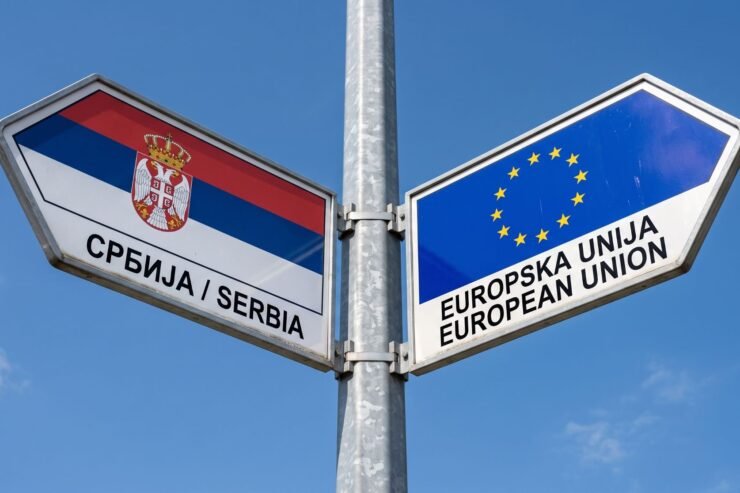
The official political class speaks in EU imagery. Government rallies still display the EU flag as a badge of legitimacy. But the protest crowd, despite being overwhelmingly drawn from a society that wants accession, does not seem to be using the EU as its language in the same way. I want to caution against drawing conclusions about the average Albanian’s pro-EU stance: he/she is largely pro-EU. I have made this argument in my previous article, and I have no reason to believe it has changed. What I believe has changed is the nature of their perception of the EU, recalibrated from wide-eyed belief to pared-down, realistic expectations. There is a sense that while accession may be a desired outcome, positive pronouncements by EU officials are not a perfect measure of good governance, nor are they strongly correlated with daily reality.
I notice a break – it seems idealism did not survive contact with EU diplomacy. I want to be clear here: the Albanian public has not abandoned the EU. It has begun to distinguish between the EU as an aspiration and EU diplomacy as a measure of reality.
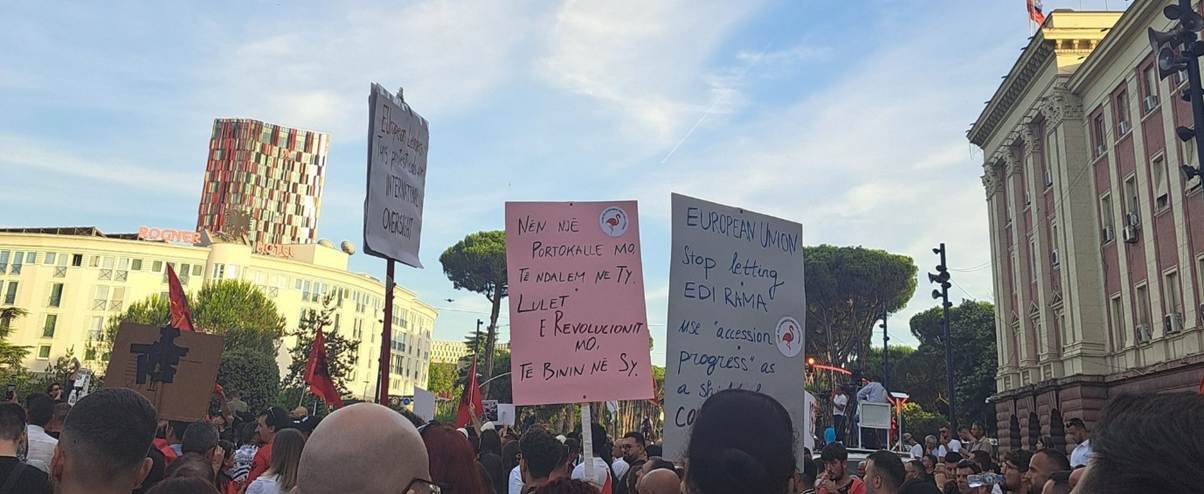
Figure 1: Europe stop letting Edi Rama use ‘accession progress’ as a shield for corruption (the last two words are a guess)
In 2025, 91% of respondents to a survey said they are pro Albania’s EU accession, but only 46% thought it would happen in the next 5 years. This was after the government unleashed a strong propaganda campaign claiming that Albania was getting closer to the EU, accompanied by a series of EU officials making the usual declarations that Albania belongs in the EU, that its path is set, and a series of other enthusiastic but non-binding statements. Chapters were opened at a dizzying speed, although all remain open. A year ago, a flurry of visits, statements, and an overall mood of optimism seemed to have captured the Albanian political scene.
Yet, less than half of the population seems to have gotten the memo. It is likely that the average Albanian observes two contradicting signals. On the one hand, he sees the endless cases of corruption plaguing the government. On the other hand, he watches a parade of EU officials making optimistic pronouncements about Albania’s prospects of entering the EU.
For an ordinary citizen, the two stories are hard to reconcile. I am not saying that Albania can’t make technical progress while corruption cases exist. That can happen. The contradiction is that the official story often treats procedural movement toward the EU as a validation seal for government performance. Many Albanians no longer seem willing to make that leap.
There may be some recalibration happening within the Albanian public. It involves understanding that EU interests are not perfectly aligned with local needs. That in the impure game of diplomacy, the weight EU diplomats place on local land dispossession may not be exactly large. That the EU may be willing to sacrifice some local concerns for other, larger and more distant affairs that have nothing to do with our daily reality.
This recalibration may have led to the realization that the national interest cannot be outsourced. Foreign diplomats can help, pressure, and sometimes discipline local elites. But they do not live with the consequences in the same way citizens do, nor do they get punished at the ballot box when those consequences prove dire. The final burden of accountability has to remain domestic. These things would be obvious to a political scientist. The general public, however, may have started further from this position and, given recent conflicting signals, changed its view accordingly.
The EU accession game reshapes domestic politics, but not always for the better
Say that you were to ask yourself the question: As an Albanian, has being overwhelmingly pro-EU helped or hindered domestic politics? That sounds like a strange question. At first, it seems nonsensical. How can being pro something positive have any negative effects? I am pro-EU and always thought that the more influence the EU had on Albanian affairs, the better off we’d be. It turns out I may have been a bit naive.
Like almost everything else, attention is scarce. The EU bureaucracy has to allocate most of its attention to pressing issues, especially after the war in Ukraine, which is understandable. Compared to military spending, Albania is not a priority. But even within the scant attention we may receive, the EU, while placing some weight on Albania being well-run and democratic, may place more weight on other objectives that, though not directly in conflict with the former, may induce trade-offs that push it into unpleasant bargains.
In the great scheme of things, the EU has less skin in the game than we do, and if our political system is completely captured by a corrupt clientelist regime, this is basically our problem to solve, not theirs. Even if they wish to apply pressure to the system, doing so may disturb the status quo and introduce political risks to EU strategy in the region, and bureaucracies don’t like to rock the boat.
There is a name for this bargain: stabilitocracy (or stabilocracy) – usually associated with Srđa Pavlović, who used it in 2016 to describe Western tolerance for Balkan strongmen who present themselves as guarantors of stability, while hollowing out democracy at home. An earlier version of the idea was applied to Albania in 2012 by Antoinette Primatarova and Johanna Deimel, who described the country as providing external stability while oscillating domestically between democratic and autocratic tendencies. The concept is useful because it captures the exact distortion produced by the accession game: the local ruler does not need to govern well. But he does have to appear useful, predictable, and stabilizing to the outside world. The EU wants good governance, but it also wants manageability. And when those goals conflict, manageability often wins.
This produces an odd equilibrium where, because Albanians are so pro-EU, EU approval becomes domestic political capital. A politician praised by Brussels gains credibility at home. So Albanian politicians learn to perform alignment: attend summits, echo EU language, avoid regional disruption, and present themselves as useful partners. When political success depends on impressing Brussels, strange things start to happen. Politicians spend more time flying to European capitals, hiring foreign consultants, and less time fixing local issues.
The change in the Albanian public’s perception is subtle and probably healthy. The public is beginning to distinguish between Europe as a desired future and European diplomacy as an imperfect political actor. That distinction matters because EU approval has become a form of domestic political currency. Once politicians understand that Brussels can validate them in the eyes of Albanian voters, they learn to optimize for Brussels. And nowhere is this clearer than in Albania’s handling of Kosovo.
Kosovo as the stress test
Kosovo should have been the exception to this pattern. It is the issue on which no Albanian government can afford ambiguity. Support for Kosovo is part of the country’s political identity. And yet, because Kosovo is such a hard case, it reveals the incentive structure more clearly. In Kosovo’s case, Albania’s concrete actions often followed the logic of European manageability more than the logic of national interest.
The problem was visible before Banjska. By the spring of 2023, the Brussels/Ohrid process was already under serious criticism. Marc Weller, who has advised Kosovo governments, argued that the EU-facilitated dialogue had become deeply unbalanced. His critique was that Serbia had refused to sign the Basic Agreement as Kosovo was prepared to do, yet the process continued as though the deal existed, while pressure shifted overwhelmingly onto Kosovo to implement the parts Serbia cared about most. According to Weller, at Ohrid, the EU facilitator even placed a blank signature page before Kosovo’s prime minister and pressed him to sign alone, after Vučić had refused to sign any agreement.
In June 2023, Rama sent Macron and Scholz a draft statute for the Association of Serb-majority Municipalities. The striking part was that he acted without being asked publicly by Kosovo, without consulting Kurti, and without any formal mandate from the dialogue parties. Prishtina understood the move exactly for what it was: not brotherly advice, but an intervention into Kosovo’s negotiating position. Kurti’s office responded that the Association was not a technical drafting issue but a matter of the functionality of the state of Kosovo.
Rama then canceled the normal format of the joint Albania-Kosovo government meeting scheduled for Gjakova. His explanation was that Kosovo’s relations with the Euro-Atlantic community were worsening by the hour, and that the planned meeting would create a false picture of reality. This matters because it shows Albania was capable of action. But that action was directed at Kosovo, not Serbia.
A few months later, Banjska happened. On 24 September 2023, an armed Serb group attacked Kosovo police in northern Kosovo, killing Sergeant Afrim Bunjaku. Milan Radoičić, the former vice-president of Srpska Lista, later claimed responsibility and was accused by Kosovo prosecutors of leading and organizing the attack. Serbia briefly detained him, but he was released by a Belgrade court.
This should have been the moment when the logic of the dialogue was reassessed. The facts were damning. The alleged organizer of a deadly armed attack in Kosovo had admitted involvement, remained in Serbia, and did not face meaningful accountability there. If the premise of the Brussels process was that both sides had to normalize relations through restraint and implementation of obligations, Banjska exposed how flawed that premise was.
Albania’s language after Banjska was strong, but the practical political line did not change very much. In post-Banjska remarks, Rama said Albania’s position on Kosovo’s behavior in the dialogue remained the same as the EU’s and the U.S.’s. He repeated that Kosovo should table a draft Association statute and remain inside the Franco-German plan.
This is the asymmetry. Before Banjska, Albania used concrete pressure when Kosovo was out of step with Brussels. After Banjska, when Serbia-linked actors shattered the premise of normalization, Albania condemned, but did not demand a reset of the process. It did not turn Banjska into a condition for Albania-Serbia relations. It did not use comparable pressure against Belgrade.
This is why Michael Roth’s later admission matters. Roth, a former German Minister of State for Europe and later chair of the Bundestag Foreign Affairs Committee, said in an interview that he had been wrong to believe for so long that Kosovo’s European path should depend so heavily on progress in the normalization dialogue. The dialogue, he said, was never well balanced. Progress mattered far more to Kosovo than to Belgrade, which meant Vučić could use the process as a blocking instrument. It was a structural flaw that some European politicians recognized too late.
Albania treated the EU-managed dialogue as if it were automatically synonymous with responsibility, even when the dialogue itself was producing perverse incentives. For Albania, this reveals the domestic political danger of the EU accession game. A government that wants external validation learns to speak the language Brussels rewards: stability, coordination, restraint, alignment. In the Kosovo case, Albania’s most concrete interventions were aimed at making Kosovo easier for Brussels to manage.
The Current Protests as a Test Case
The clearest domestic example of interest misalignment is unfolding before our eyes. Zvërnec, Sazan, Rrjoll, and other protected landscapes should be exactly the kind of case where EU integration helps domestic politics. It touches almost everything the EU is supposed to mean in practice: rule of law, property rights, and environmental protection.
The facts are clear. SPAK has opened an investigation into changes made in 2024 to the area’s protected status and land ownership around the Sazan/Vjosa-Narta project. The European Parliament then adopted a resolution calling on Albania to repeal the 2024 amendments to the Law on Protected Areas and demanding an immediate moratorium on new permits and construction works until Albanian law is brought back into line with EU nature-protection standards.
This should have been a moment of maximum clarity. Citizens were in the street. SPAK was investigating. Environmental groups were warning of irreversible damage. The European Parliament was saying stop. If EU accession were functioning as the clean external referee we once imagined, this is where the government’s “European” credentials should have become a liability.
Instead, EU diplomacy quickly returned to the language of reassurance. Commissioner Marta Kos said the Commission had received assurances from the Albanian government that a full environmental impact assessment would be carried out and that European environmental standards would be respected. She added that the accession process itself is legally and politically binding and therefore offers the strongest guarantee that Albania’s nature will be protected in line with European standards.
But that is precisely the problem. Citizens are protesting because, in their lived experience, chapters, benchmarks, reports, or European language have not stopped the fraudulent machine from moving. The government only needs the EU to say “we have received assurances,” and “Albania remains on track.”
This is where wanting the EU can start hurting domestic politics. A deeply pro-EU public gives EU language enormous domestic weight. Once that happens, the government learns to harvest it. A commissioner’s cautious reassurance becomes proof that the protests are exaggerated. Another approved step in the accession process can be turned into a certificate that the state waves at its own citizens.
In a captured political system, EU accession can stop being a constraint on power and become one of power’s favorite instruments. That is the danger. We have allowed European approval to become a substitute for domestic legitimacy.
(c) 2026 Elton Dusha. Të gjitha të drejtat janë të autorit.
Discover more from Peizazhe të fjalës
Subscribe to get the latest posts sent to your email.