Notes on the International Sound and Radio Art Festival PRISON RADIO from 10-13 September 2026 in Prishtina
After some weeks, what remains from the four days of PRISON RADIO, alongside the programme, the artworks and the radio broadcasts, are above all the sequences of random, arbitrary, parallel and simultaneous encounters. All what you could call glücklicher Zufall; serendipity. Conversations in the courtyard of the former Prishtina Prison, now a museum known as the Prison of Ideals, between two broadcasts, a conversation overheard in a corridor, the momentum of a conversation during a live broadcast, a question asked after a lecture that opened up a myriad of other discussions, a late-night exchange of stories and laughter at Hani i dy Robertëve, while Kolektiv Radio was still on air and Lumpen Station relentlessly continued to broadcast. Each of these moments was singular, connected to one person, one voice, one biography. And still, looking back, they did not remain fragments or definitely where not by chance. Across performances, live broadcasting, radio pieces, sound installations, lectures, masterclasses, an exhibition in 14 cells across the Former Prishtina Prison, listening walks and a poetic community run, these individual perspectives slowly composed a common picture.
Among these encounters during the festival was also the spirit of Alexander Kluge. In February 2025, a little over a year before his death, he joined our collective via live connection for The Assault of the Present on the Rest of Time, a retrospective of his work at Kino Armata. During the retrospective in one of his minute films, which he sent as a gift to the retrospective, he suggested that the subjective is the most objective. Rarely have we felt the truth of his proposition the subjective is the most objective as clearly as during these four PRISON RADIO festival days.
Alexander Kluge’s seminal film Yesterday Girl (Abschied von gestern, 1966) gives us a lead as many categories we discussed during the PRISON RADIO festival align here. The film opens with the statement “We are not separated from yesterday by an abyss, but by the changed situation.” It is followed by several questions as if spoken at a final judgement: “Did he separate the daughter from the mother? Did he not release a prisoner, not loosen his bonds? Did he not let one who was imprisoned see the light?” Only then does the court case against Anita G, the main character, which is played by Alexander Kluge’s sister Alexandra Kluge, begins. She stands accused of having taken a colleague’s cardigan. The judge reconstructs her life in a few dry questions: she came over from the region of Leipzig in 1957, her grandparents were persecuted as Jews in 1938, as a child she was partly excluded from school, she worked as a telephone operator and wanted to learn something. When she says that she suddenly became afraid, and that this fear stems from earlier events, the judge cuts her short. What she might have perceived as a child in 1943 or 1944 could hardly have anything to do with her present situation “according to experience, such things do not linger in young people”.
The scene is an acoustic one as much as a legal one. The judge asks her to place her hands calmly on the table and to stay calm. He offers her answers, and she repeats them. Her own voice appears only in fragments. A yes, a certainly, a hesitation. In these few sentences of the scene lies everything the institution refuses to hear. A history that does not end with the abyss of 1945 but continues to act within a body, in the changed situation. What cannot be established within the file is precisely what the subjective knows. Watching Anita G, we can draw some entry points revisiting the subjective in our own work with sound, radio and incarceration. Of listening precisely where institutions decide that a personal history has no impact on the present. Of making room for the voice that in the courtroom is only allowed to say yes.
Therefore, when Hava Shala recalls at the PRISON RADIO opening that she had to keep singing in solitary confinement and that nowhere does a song sound more beautiful than in prison, this is not an individual anecdote placed besides history. It is history, told at the only scale at which it can be told honestly: the scale of a body, a voice and a memory that refuses to disappear. Also at the festival opening, Martin Çuni, once imprisoned within these very walls, where he also attempted to escape, read aloud a letter to his wife Mrika, her name echoing through the courtyard, while his own life had been profoundly shaped by his imprisonment, but also by his work at different radio stations, before and after his imprisonment. These are just some examples of many accounts that do not claim to represent the whole. Precisely because they do not, the whole becomes audible through them.
Radio against the walls
From the very beginning, one question accompanied us: how can one create art in the face of imprisonment? How can one even think of making art, of using radio, in a place that was built to isolate and to silence people? There is always the risk of aestheticising suffering, of turning a site of violence into a background. Art is easily over-explained, its lessons spelled out in advance, or drawn towards sensation, where suffering becomes spectacle. What moved us was how many works refused both, leaving room for silence, for the perspective of those who were imprisoned, and for the listeners and how many unexpected moments grew out of this restraint. Often there was not one meaning, only points of entry for discussion and exchange about a piece and what it evokes, from the perspective of the artists and, most importantly, from that of the listeners and former prisoners. The art works resisted to over-educative art, shape their work to logic of impact which explains itself to the point of exhaustion and leaves no space for ambiguity, doubt or the unsayable. And the art works resisted, on the other side, to exploit the sensation, where trauma becomes spectacle and suffering is staged for affect.
The awareness of this restraints’ dichotomy was countered with research and knowledge sharing. Alban Beqiraj spent months over months gathering more than 100 pages of literature, poetry, letters and testimonies of imprisonment from Kosova and Albania to the wider region and beyond. The reader sometimes includes pages and pages of titles, names, authors or web links to relevant material. It became a shared point of reference for artists, contributors and the curatorial collective and a reminder that every work in the festival entered into dialogue with voices that had written, sung and spoken from behind prison walls long before us. In the end, we did not resolve this question, and we do not think we should have. What the festival did show us is that the artists worked with a precise awareness of trauma rather than around it and that this awareness gave their work its particular gravity.
However, we saw that radio has a specific place in this. In Ibish Neziri’s account from the prison in Staragradishka/Stara Gradiška, prisoners secretly built a receiver from a cardboard box, toothpaste caps and improvised parts and listened at night with their heads under the blankets to various stations. The radio was forbidden as an object, but it opened a channel to a world the prison sought to cut off.
For a total of 72 hours and 12 hours of daily live broadcasting, Lumpenstation turned the Former Prishtina Prison into a transmitter and receiver, while Kolektiv Radio carried the listening into the social and public space of Hani i dy Robertëve. The masterclass Mobile Radio: 20 years of Radio as Art with Sarah Washington and Knut Aufermann, and the concert of Tonic Train with the HAM Radio Orchestra Kosova, during which amateur radio operators communicated with people across Kosovo’s borders, bringing their voices and conversations into the prison courtyard, reminded us of that radio beyond its broadcasting function, also has a community dimension: people speaking, listening, producing and remembering together. Perhaps this is the paradox we lived through: art and creativity seem almost impossible in this place, and at the same time they appeared as the only way out. Singing, reciting, knocking, listening, transmitting, repeat.
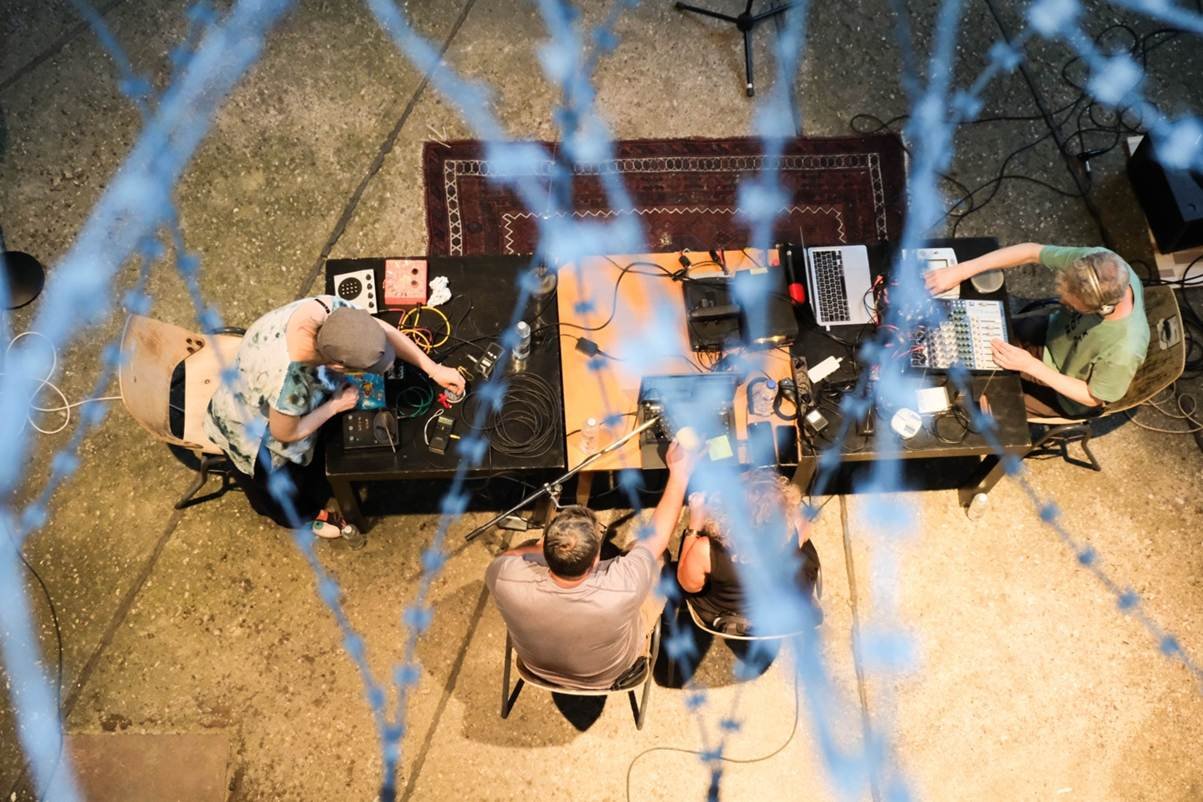
Prishtina Prison, PRISON RADIO 2026. Photo: Zana Begolli
An Aural Shift on the Prison Continuum
When Ilir Bajri opened the festival in the large prison courtyard with a sonification of Michel Foucault’s Discipline and Punish, the architecture itself seemed to crack open under the force of sound. Through fragmentation, intense musicality and vocal estrangement, Foucault’s text was constructed and deconstructed in real time, moving between different languages, voices, tones and temperatures. As language dissolved into sound, understanding no longer depended on the meaning of words alone, but emerged through the experience of listening itself.
It is precisely here that Salomé Voegelin’s philosophy of listening introduces what we might call an aural shift: a movement away from a visually dominated order of surveillance, classification and control towards listening as a way of producing knowledge and social relations. In Listening to Noise and Silence. Towards a Philosophy of Sound Art, Voegelin challenges the apparent certainty of visual knowledge, proposing listening as an immersive and participatory practice in which the listener cannot remain outside what is heard. Rather than observing a world already constituted, listening implicates us in its ongoing production. Listening is not inherently emancipatory but opens the possibility of questioning and renegotiating the relations of power through which we perceive and relate to one another. And perhaps this was precisely what PRISON RADIO set in motion within us: an almost imperceptible shift in ways of thinking and perceiving, as listening gradually became the very means through which we began to understand the suffering that emerges from the encounter between the inmates’ stories and the prison as a spatial point of reference.
Theodor W. Adorno had already sketched a related figure of thought. In his notes Towards a Theory of Musical Reproduction, he grounds true interpretation in what he calls a listening logic and writes that the listener who disappears into the work is the very one who makes it real. What may sound like a paradox describes, we believe, what listening asks of us. A song in a cell, a knock through a radiator or a faint radio frequency does not exist as a finished object that can be surveyed from a distance. It unfolds only in time, and only for someone willing to follow it. Such listening is neither passive nor possessive. It requires setting aside one’s own expectations to follow the rhythm, the pause and the hesitation of another voice and precisely in this attentive surrender the listener becomes part of how meaning comes into being. Voegelin’s participatory listening and Adorno’s listening logic meet here, and both lead back to Kluge’s insistence that the subjective is the most objective. The subjective does not become objective by asserting itself, but by being willing to lose itself in what another person has to say.
Instinctively referring to this role of listening, sound and noise, many of the contributions to the festival have complemented each other. In his lecture, Labinot Kelmendi drew on Salomé Voegelin, Jacques Attali and Kadare’s neologism zhurmhuria (noiseology) to explore the ontological, aesthetic and sociopolitical dimensions of noise, proposing it as a possible departure from the regime of visuality and a way of rethinking the relationship between sound, power and social transformation.
Unconscious historiography
In Aesthetic Theory, Theodor W. Adorno describes art as the plenipotentiary of a better praxis and unconscious historiography of their epoch. The formulation helped us to understand what happened in these days. None of the pieces set out to write the history of the Former Prishtina Prison, of political imprisonment, or of incarceration in Kosova, Albania, Belgium, Colombia, Syria or Brazil. And yet, in their form, in their silences and interruptions, they wrote it nonetheless. Toni Dimitrov’s Listening Backward, Nuno Ramos’ 111 with the reading of the names of the prisoners killed at Carandiru, the songs of the 1972 Festivali i Këngës that were followed by persecution: history entered these works not as content but as sedimented experience.
The exhibition Sound, Resisting brought these questions into four prison blocks, the watchtower and the courtyards of the Former Prishtina Prison. Cells once built for isolation were filled with voices, from Adem Demaçi’s words and Zef Pllumi’s testimony in conversation with Elsa Demo to The Auld Triangle, sung by the In and Out Choir. Hazir Reka’s Dalja nga Terri presented a rare photograph capturing the moment of a prisoner’s release from the Former Prishtina Prison, while PRISON × LOVE explored the social regulation of intimacy and the tristesse surrounding it. In another cell, Thomas Krempke’s installation Befas u zgjove… (You suddenly woke up…) took as its point of departure Ëndrrat, a poem Visar Zhiti wrote in 1982 while imprisoned in Spaç where it appeared in sign language. Celda B-8 ¼ by Juan Camilo Herrera Casilimas and Andrés Arizmendi shifted the gaze towards contemporary political developments and the realities of incarceration in Colombia.
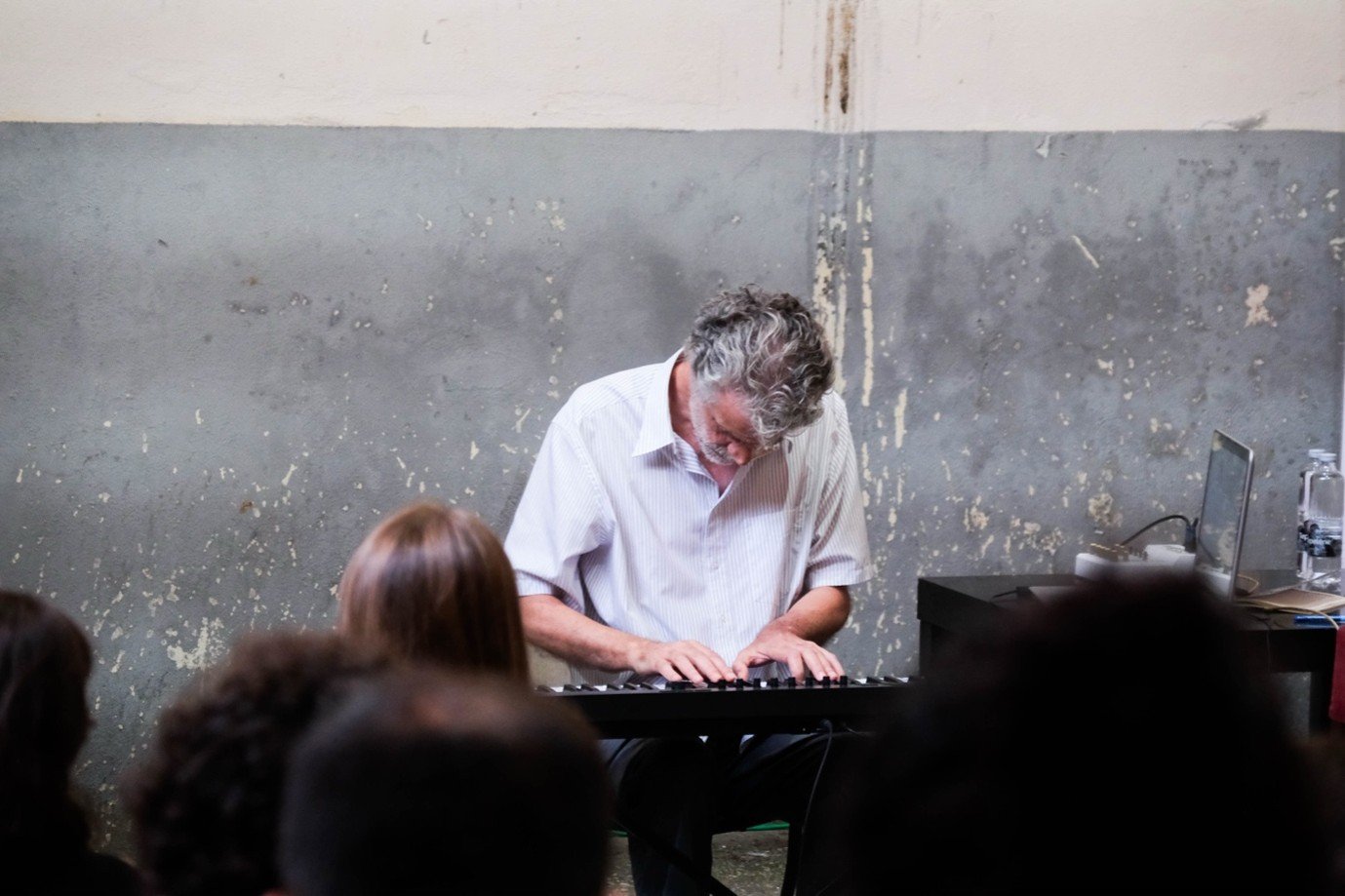
Ilir Bajri, adaptimi tingullor i Disiplinë dhe ndëshkim, hapja e festivalit, ish-burgu i Prishtinës, PRISON RADIO 2026. Foto: Zana Begolli (Ilir Bajri, sonification of Michel Foucault’s Discipline and Punish, festival opening, Former Prishtina Prison, PRISON RADIO 2026. Photo: Zana Begolli) 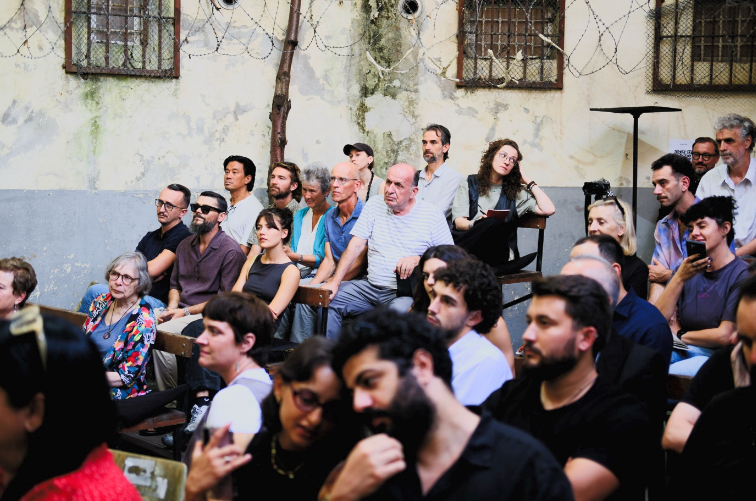
Publiku në oborrin e ish-Burgut të Prishtinës, PRISON RADIO 2026. Foto: Zana (Audience in the courtyard of the Former Prishtina Prison, PRISON RADIO 2026.) 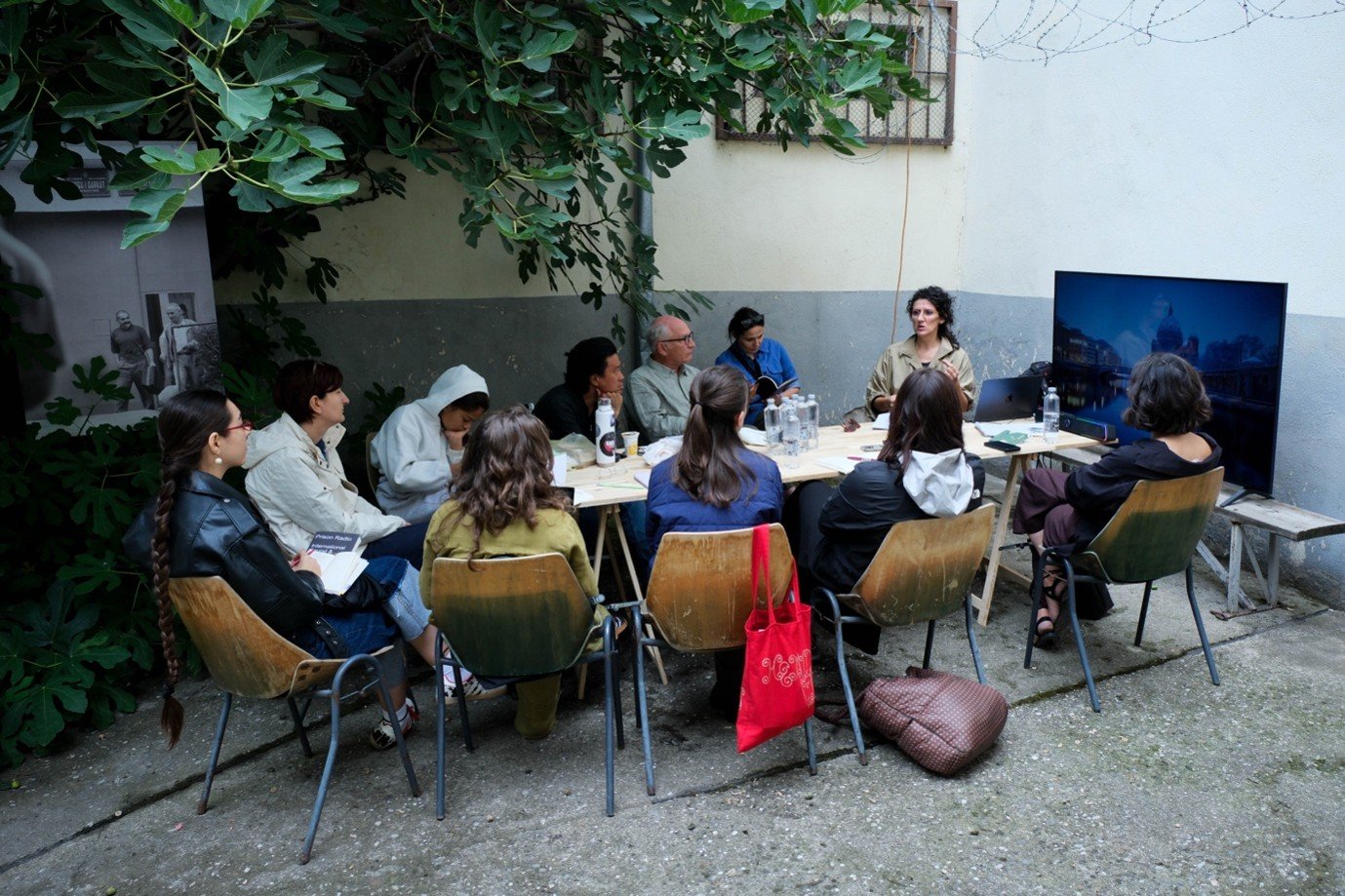
Eli Krasniqi, masterklasë Arkivat në pezullim, ish-Burgu i Prishtinës, PRISON RADIO 2026. Foto: Zana Begolli (Eli Krasniqi, masterclass Archives in Suspension, Former Prishtina Prison, PRISON RADIO 2026. Photo: Zana Begolli) 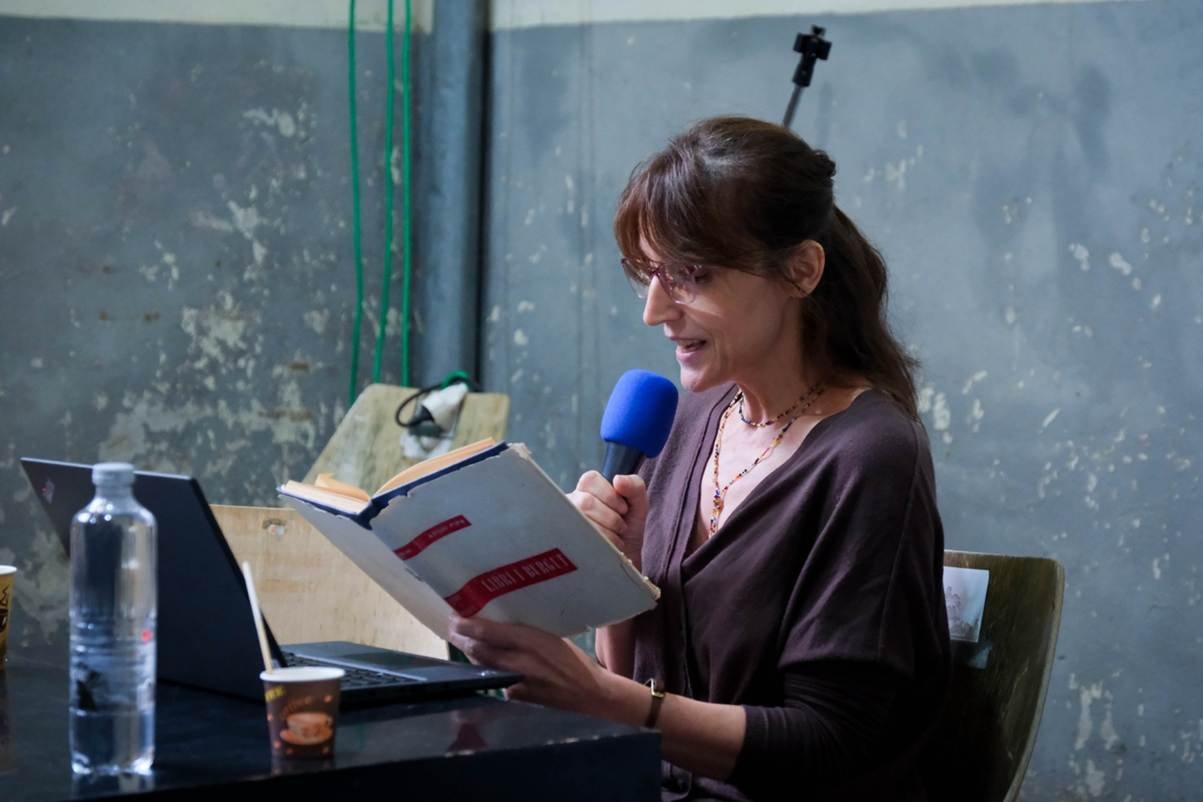
Elsa Demo, ese radiofonike live Prej heshtjes së fjalëve, lexim nga Libri i burgut i Arshi Pipës, ish-Burgu i Prishtinës, PRISON RADIO 2026. Foto: Zana Begolli (Elsa Demo, live radio essay From the Silence of Words, reading from Arshi Pipa’s Libri i burgut, Former Prishtina Prison, PRISON RADIO 2026. Photo: Zana Begolli) 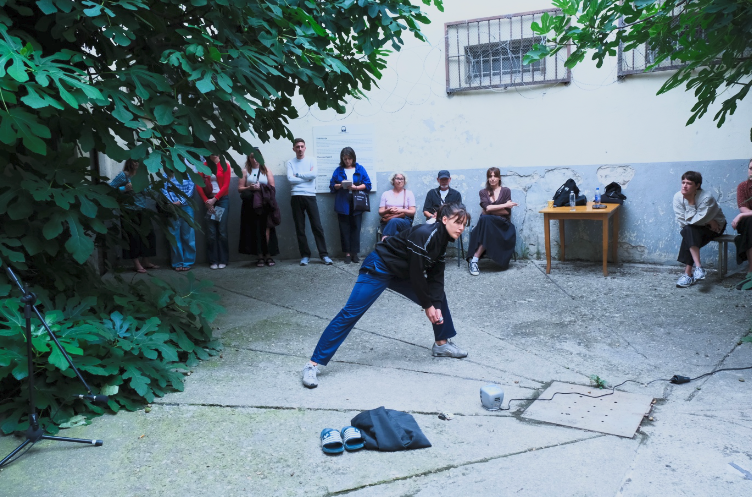
Anouk Albrecht, Episode 6, performancë në oborrin e ish-Burgut të Prishtinës, PRISON RADIO 2026. Foto: Zana Begolli (Anouk Albrecht, Episode 6, performance in the courtyard of the Former Prishtina Prison, PRISON RADIO 2026. Photo: Zana Begolli) 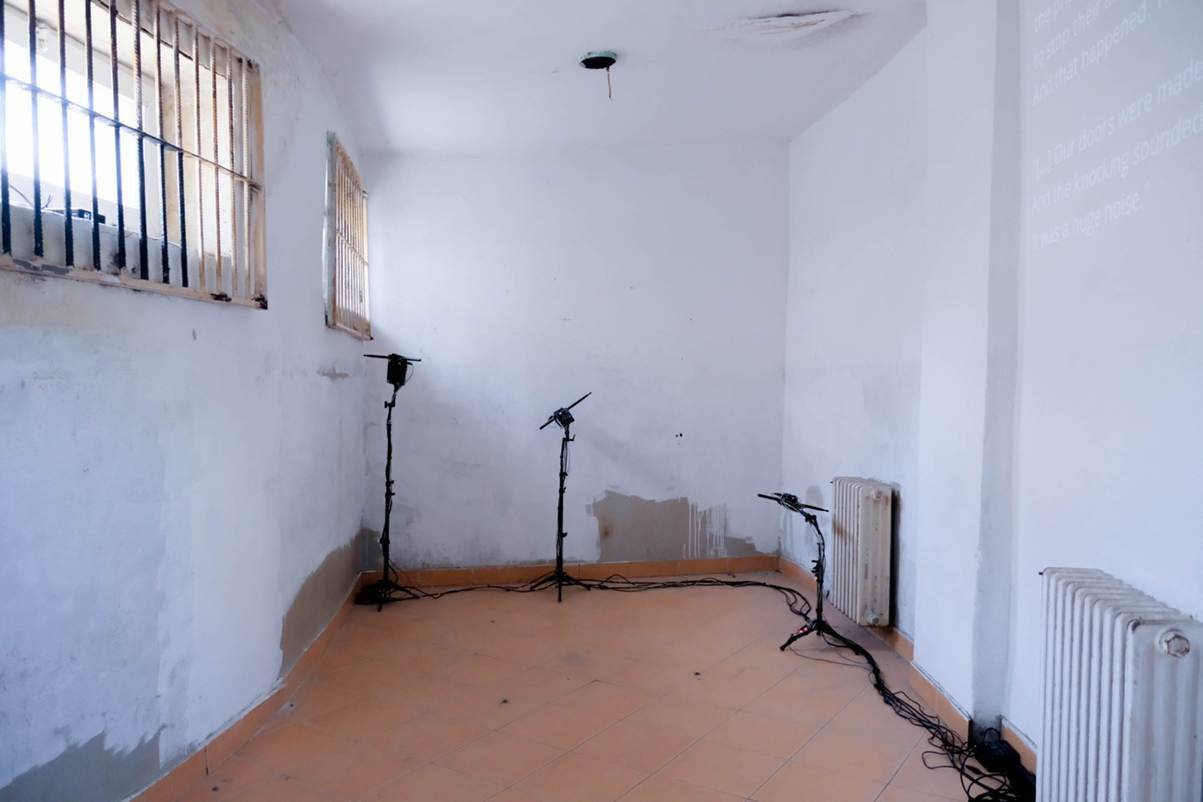
Adina Camhy, so that we’d never feel alone, sound installation, exhibition Sound, Resisting, Former Prishtina Prison, PRISON RADIO 2026. Photo: Zana Begolli (Adina Camhy, so that we’d never feel alone, instalacion tingullor, ekspozita Sound, Resisting, ish-Burgu i Prishtinës, PRISON RADIO 2026. Foto: Zana Begolli)
Other works approached these histories through the very conditions of communication and its interruption. In Adina Camhy’s installation so that we’d never feel alone the knocking signals exchanged through walls and radiators returned: the architecture of separation became once again an infrastructure of communication, turning the entire building into an instrument. In her concert PRISON x BODY, Adina weaved together works and improvisations from the last three years, during which she has been struggling with post-Covid syndrome: field recordings from the rugged karst landscape, improvisations recorded on a wooden church organ in an Alpine mountain village, and poem-like fragments dealing with chronic illness and hope; the body as prison. Then there was Sarah Washington’s Different Light in the watchtower on the life and love story of Abdullah and Akile Zhegrova, who were connected through their shared experience of imprisonment. Maja Zećo’s Defend and Protect with its weighted vest carrying the sound of military drones, brought another dimension of confinement into focus, where sound itself becomes a means of intimidation and control. In Anouk Albrecht’s Episode 6, faint radio frequencies established connections that were repeatedly lost and restored, making the fragility of communication itself audible. And Knut Aufermann’s closing listening walk remnants & seeds invited us to listen differently to the surrounding environment of the Former Prishtina Prison, to what remains and what might still emerge. Each in its own way, these works explored the threshold between confinement and transmission, between the possibility of connection and its constant fragility.
Across different geographies, histories and artistic approaches, the exhibition opened a dialogue between past and present, between the prison as a historical site and imprisonment as an ongoing political reality. This historiography lives in a dialectic that cannot be closed, an in-betweenness of potentiality and impossibility. Adorno’s conclusions on how art is possible after tremendous suffering is barbaric is often quoted, but relatively unknow his later statements in Negative Dialectics, where he writes that suffering has as much right to expression as a tortured person has to scream. The works did not dissolve this ambivalence and tension. They made it audible.
Eli Krasniqi’s masterclass Archives in Suspension spoke of the fragmented archive of gendered experiences of imprisonment in Kosova of how secrecy, imprisonment and delayed recognition shape the writing of history. In her lecture Gendered Histories of Resistance and Imprisonment, she explores Albanian women’s participation in Ilegalja, Kosovo’s underground resistance movement during Yugoslav socialism, focusing on their political formation, imprisonment, and solidarity through singing in prison. Associated with the major demonstrations of 1968 and 1981, Ilegalja represented resistance to both state authority and patriarchy. Krasniqi traces women’s emergence as political subjects through family memories of oppression, education, friendships, and networks of trust. She also highlights how underground publications, particularly Kosovarja e Re, documented women’s resistance and the courage of those imprisoned in 1981.
Elsa Demo’s live radio essay From the Silence of Words explores Albanian authors who wrote under communist repression, creating a countercultural literature of resistance outside official circulation. Often written without readers but sustained by the hope of future recognition, their works preserved literary autonomy and served as documentary testimony. Demo highlights Kasëm Trebeshina, Jamarbër Marku, Shpëtim Gína, Zef Zorba, Father Zef Pllumi, Arshi Pipa and Maks Velo, whose writings challenged the dominant literary model and enriched Albanian literature. As Demo argues, these authors reflected on their times, restored human values suppressed by the dictatorship, and produced works of lasting artistic, aesthetic and historical significance. In her second contribution to the live radio sessions, From the Ashes of Images, Demo spoke with Krenar Zejno about Maks Velo, who was sentenced in 1978 for defying the doctrine of Socialist Realism and whose works – some 264 of them – were confiscated and burned by the secret police. Three of his lithographs were also shown in the exhibition.
Orgest Azizi’s Drowned Voices, Wild Grass shifts attention from the prison as an optical space to its murmurs, noises and screams. Marking the centenary of Foucault’s birth, the lecture explores an archaeology of silence, tracing suppressed and erased voices through Foucault’s recorded lectures and interviews. Structured as a journey or montage, it merges knowledge and art, episteme and poetics, reflecting PRISON RADIO’s experimental approach to recovering forgotten voices. Azizi calls for a new historical method grounded in absences, fragments and incomplete testimonies rather than dominant discourses. He also examines Foucault’s anti-Platonic reversal of the relationship between body and soul: rather than the body being the tomb of the soul, the soul becomes a technological product of power designed to subjugate the body.
Reproduction and presence
Walter Benjamin wrote in The Work of Art in the Age of Mechanical Reproduction that which withers in the age of mechanical reproduction is the aura of the work of art. Radio is kind of the ideal medium of this withering: a voice detached from the body, multiplied, sent into rooms the speaker will never enter. And yet something curious happened at PRISON RADIO. A medium of communication at a distance was brought back into a place. In a courtyard, in a cell, together at a table. As Kluge might have put it, radio became once again a more direct medium of the public sphere, closer to the directness of theatre, cinema or opera than to the anonymous broadcast.
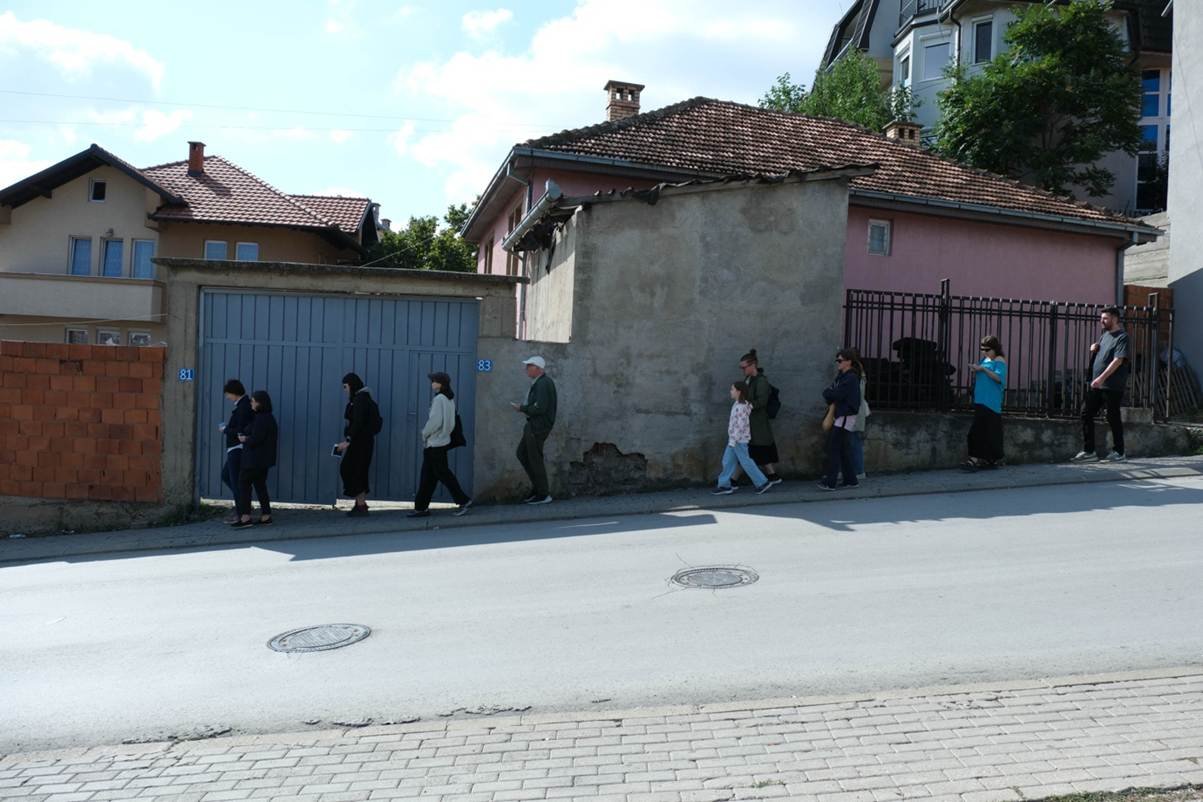
Benjamin saw reproduction as a form of emancipation, too: the work freed from its dependence on ritual, opened to new forms of reception and participation. It seems that in our time of endless reproduction and circulation, subjectivity becomes more important rather than less. When every sound can be copied, streamed and archived what cannot be reproduced is the singular relation between a voice and the experience it carries and the relation between that voice and the person who listens. The aura maybe has not disappeared entirely. It might have migrated into each of these encounters. It lives in the moment when a former prisoner speaks in the building where they were held, when a listener in a distant kitchen hears the knocking through the walls, when a participant in the soundwalk Retracing Steps, led by Maja Zećo and departing from Verena Walzl’s poem Walk to School, listens their way along Blertë Ismajli’s route to school through the years of the parallel system.
This is also why the question of the archive matters so much to us. The recordings of these days will circulate further, will be (re-)broadcasted again by other free and community radios, and will be heard in contexts we cannot foresee. Reproduction is not the enemy of memory here. It is the condition for these subjective voices to enter a wider, shared counter-public, where agency and collective remembrance meet.
What remains
The sounds have faded from the corridors of Burgu i Idealit, the Former Prishtina Prison, but the encounters continue to resonate. PRISON RADIO did not answer the question of how to make art against the experience of imprisonment. It kept the question open and in doing so it showed that listening can be a form of being together and that being together can itself be a form of resistance as the name of the PRISON RADIO exhibition Sound, Resisting suggests: a critical reflection on incarceration between past, present and future and a window to share those reflections during the festival between people and just for a moment beyond the walls, and through radio over distances, and via the archives over time. Perhaps this is what Kluge means when he insists on the objectivity of the subjective. History is not solely written from above. It is also sung in a cell, knocked through a wall, whispered under a blanket and transmitted again, sung again, recited in silence and out loud in companionship, whispered in the nights and days to come, and spoken on radio to whoever is willing to listen.
PRISON RADIO took place from 10 to 13 September 2026 at the Former Prishtina Prison (Burgu i Idealit) and at Hani i dy Robertëve in Prishtina. PRISON RADIO is an international, transdisciplinary festival for sound and radio art and discourse, conceived and curated by the PRISON RADIO Collective: Alban Beqiraj, Blertë Ismajli, Alexander Vojvoda and Verena Walzl. This text was written by Alexander Vojvoda on behalf of the Collective as a reflection on these days.
Discover more from Peizazhe të fjalës
Subscribe to get the latest posts sent to your email.